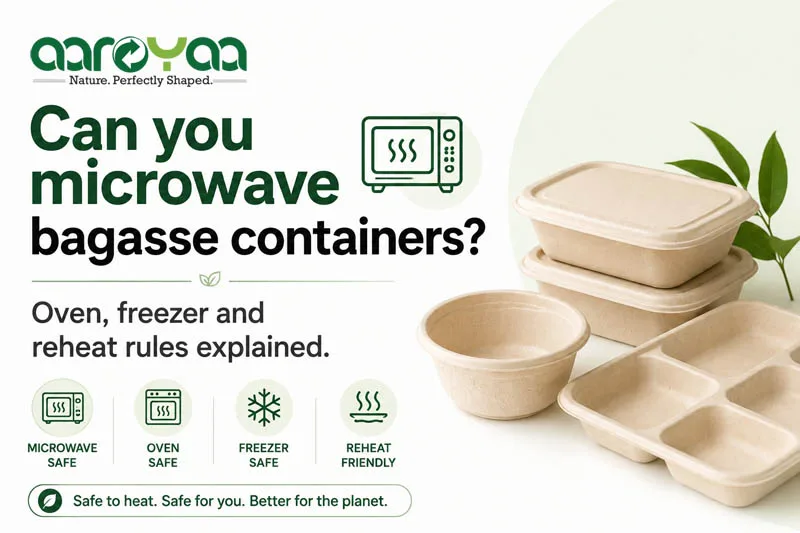
Can you microwave bagasse containers? Oven, freezer and reheat rules explained
It is 10:40 at night. Half a container of dal makhani is in the fridge, still in the sugarcane container it arrived in yesterday. You want to reheat it and go to bed. Then your hand stops on the microwave door, because you are not sure whether the thing is about to warp or leak.
Yes, you can microwave bagasse containers. Most of the time, a normal reheat does nothing to them at all. There are limits though, and there is one mistake Indian food invites in particular, which is usually what people are describing when they say the material let them down. Product pages rarely mention it.
The short version
Bagasse containers are safe to be used in the microwave for reheating. Most suppliers would say that they are safe to be used up to 100-120 degrees Celsius. That means the water-containing food like rice, dal, sabzi, pasta, soup, idli and most leftovers should be perfectly fine. The bagasse containers should only be heated for a short duration (1-3 mins) on a medium setting, and the lid needs to be kept off/resting on the top. Since the bagasse is made out of tempered sugarcane fibre without any plastic layer or wax covering, nothing will melt in your food. What it cannot handle is direct/dry heat.
Why things are the way they are
Bagasse is the residue left behind when sugarcane is crushed to extract juice. Earlier it was burnt as waste, but now it is repurposed into different items. The raw material is tempered into sheets/moulds by applying heat and pressure and then dried to make plates, bowls, trays, etc. It is plant-based and not petrochemical/plastic based and hence does not have a melting point like plastic does. It will not get all gooey/drippy at 90 degree celsius.
But fibre does something else. It scorches. Push it far enough past its rated temperature and it browns, then chars, the way a chapati left too long on the tawa does. It also holds a small amount of natural moisture, and that moisture is doing quite structural work. Boil it off with too much heat, and the container gets brittle in that spot.
So the rule is not really about temperature alone. It is about what kind of heat and for how long.
The oil problem, which is the one that actually catches people out
Here is the mistake. Water cannot get hotter than 100°C in a microwave. It turns to steam and stops. That is why reheating rice or dal is completely safe.
Oil is a different story. Fat has no such ceiling. A pool of ghee or oil sitting in the corner of a container can climb well past 200°C while the food around it is still merely warm. And bagasse fibre was never designed for that. What you get is a brown scorch ring, a soft patch, sometimes a small leak through the base.
This matters more in an Indian kitchen than almost anywhere else. Think about what actually collects at the bottom of a container of chicken korma, a mutton curry, a paneer butter masala, or anything finished with a tadka. It is a layer of oil. Then think about biryani that has been sitting overnight, or leftover pakoras, or anything fried.
What to do about it:
● Stir the food halfway through instead of running one long cycle. Stirring breaks up the hot oil pockets.
● Use medium power, not full. It takes thirty seconds longer and removes most of the risk.
● If there is a visible layer of oil pooled on top, spoon some off before heating.
● For very oily leftovers you plan to reheat more than once, move them to a steel or glass container. We would rather say that honestly than pretend bagasse is the answer to every situation.
None of this is exotic advice. It is the same reason your microwave splatters when you heat pakoras but not when you heat rice.
Lids: check yours before you press start
This trips up more people than the food does.
The container base and the lid are often two different materials. Bagasse lids behave exactly like the container and go in the microwave without any issue. But clear, shiny, slightly brittle lids are usually plastic, and plastic lids have far lower heat tolerance. If you can see through it and it flexes with a crackle, take it off.
Second point, and this one applies to every lid regardless of material. Never microwave a container that is sealed shut. Steam has to go somewhere. Sealed lids build pressure, then pop, and you spend ten minutes cleaning gravy off the roof of your microwave. Rest the lid loosely on top if you want to avoid splatter, or leave a corner open.
On our own kitchenware range, the lids are sold as separate items so you can match them properly, for example a lid for the 250/350 ml bowls at ₹9.34 per piece, or the 750 ml container lid at ₹25.28 per piece. If you are ordering for a business and reheating is part of how customers will use the packaging, ask us which lid pairs with which base before you place the order.
Oven and toaster oven: be careful, and be honest about the disagreement
This is where suppliers genuinely do not agree, and you deserve to know that rather than get a confident one-line answer.
Some manufacturers publish a working range that goes up to 200°C and market their bagasse containers as oven safe. Others state clearly that bagasse should never go into a conventional oven, toaster oven or grill, because dry radiant heat can scorch or even ignite plant fibre.
Both positions exist in the market. Our recommendation is the conservative one: treat bagasse as microwave safe and oven unsafe unless the specific product you bought is labelled otherwise by the person who made it.
The reason is the type of heat. A microwave excites water molecules inside the food, and the container stays relatively cool. An oven blasts the container itself with dry heat from all sides, with nothing capping the temperature. Those are not comparable situations, even at the same number on the dial.
Definitely avoid, in every case:
● Grill mode and the top browning element
● Air fryers, where hot air moves fast and directly across the surface
● Direct flame or a stovetop, including a tawa or gas burner
● Any dry heating with an empty container, which can scorch quickly with no food to absorb the energy
If you are running a cloud kitchen or a tiffin service and your customers might reheat in an OTG, print the instruction on the label. Something as plain as "microwave only, open the lid before heating, do not use in oven" prevents most complaints.
Freezer and fridge: mostly good news
Bagasse handles cold far better than heat. Fridge storage is completely fine. Freezer storage is also fine, and some suppliers rate the material down to around -25°C.
The catch is what happens next.
Do not take a container straight from the freezer and put it into a microwave on full power. Two things go wrong. The fibre has absorbed moisture from frozen food and condensation, which makes it noticeably softer and more likely to sag when you lift it. And the sudden jump from freezing to boiling is hard on any material.
Thaw in the fridge overnight, or use the defrost setting first and the reheat setting after. Support the base with your palm or a plate when you lift a container that has been frozen and then heated. That single habit prevents almost every "it collapsed on me" complaint.
Also worth knowing: bagasse is not built for months of freezer life. It is single-use packaging that happens to survive the freezer, not a long-term storage box. For a week of meal prep, it is perfectly good. For something you plan to forget about until December, use a proper container.
The whole thing, in one place
Fine without thinking about it: the fridge, the freezer down to roughly -25°C, and a microwave reheat of anything water-based within that 100°C to 120°C rating. Rice, dal, sabzi, soup, idli and pasta all fall here. One to three minute bursts on medium power.
Worth slowing down for: oily and fried food, where pooled fat can superheat past the fibre's limit, and anything coming straight out of the freezer. Both need lower power and a stir or a thaw in between. A lid resting loosely on top is fine; a lid sealed shut is not.
Do not do it at all: grill mode, the top browning element, air fryers, a gas flame or tawa, an empty container heated dry, and the dishwasher. Ovens and OTGs sit in an awkward middle, since some manufacturers rate their products to 200°C and others rule ovens out completely, so assume no until your supplier tells you otherwise in writing. And once a container has been through an oily reheat, do not reuse it. The fibre has already taken in the fat. Compost it and move on.
What this means when you are choosing sizes
Reheating behaviour changes with shape, and that is worth thinking about before you order.
Deeper round containers concentrate heat unevenly, so a 1000 ml container packed to the top will need stirring more than a shallow one. Wider, flatter shapes reheat faster and more evenly. Clamshells are excellent for delivery, but the hinge area is the weakest point once the contents are hot, so lift from underneath.
From our kitchenware range, the practical picks look roughly like this. Round containers at 250 ml (₹18.00 per piece) and 350 ml (₹19.44) suit gravies, curd and portioned sides. The 750 ml container (₹31.80) works for rice-based mains and biryani portions. The 1000 ml (₹57.00) handles family portions and bulk curries. For delivery, the 8x8 clamshell at ₹31.28 per piece and the 6x6 at ₹17.86 cover most single-meal formats, while the 9x9 3-compartment clamshell at ₹31.24 keeps a dry item away from a wet one, which also means the oily portion is easier to handle when reheating.
Prices above are as listed at the time of writing and include the discounts currently running. Orders above ₹2,499 ship free.
If you are also planning to buy biodegradable plates in India for the same event or the same kitchen, remember that plates and containers get used differently. Plates rarely go into a microwave. Containers almost always do. So the thickness and shape that matter for one are not the ones that matter for the other, and it is worth ordering both rather than trying to make one product do both jobs.
A ninety-second method that works every time
- Take the lid off, or leave it resting loosely with a gap.
- Set the microwave to medium power rather than high.
- Heat for ninety seconds.
- Stir, especially through the bottom corners where oil settles.
- Heat for another sixty seconds if it still needs it.
- Lift with a hand under the base, not by the rim.
That is it. Slower than blasting it on full for three minutes, and it is the difference between a container that holds and a container that sags.
What to check before you order
If you are comparing suppliers of eco-friendly kitchenware online, three questions will tell you more than any product description:
Ask for the actual rated temperature of the item you are buying, not a general figure for bagasse as a category. Ask whether the lid is bagasse or plastic, because the answer changes the reheating instruction you pass to your customers. And ask whether the item has any coating, since some cheaper imports use a thin plastic lining that defeats the whole point of buying compostable packaging.
A supplier who can answer those three quickly is a supplier worth ordering from.
Ordering for a home, a kitchen or an event
If you are buying for a household, start with a small mix of container sizes and matching lids and see which ones you actually reach for. If you are running a cloud kitchen, a tiffin service or a café, the sizing decision is worth getting right before you commit to volume, because the wrong size costs you on both packaging and customer complaints.
You can see the full kitchenware range, including containers, lids, clamshells and trays, on our kitchenware collection. If you would rather compare the wider catalogue first, or you want to buy biodegradable plates in India alongside your containers, the combo packs group commonly used items together. For volume pricing, sampling before you commit, or help matching lids to bases, our bulk orders page is the place to start, or write to us through the contact page and tell us what you are packing.
Frequently Asked Questions
Common questions related to this article.
Can you microwave bagasse containers with the lid on?
You can lower the lid to prevent splatters, but make sure it isn't completely sealed, as steam needs to escape. If your lid is a clear plastic instead of bagasse, make sure to remove it while heating, as its heat resistance is lower than the container itself
What temperature can bagasse containers actually handle?
Most suppliers rate bagasse for roughly 100°C to 120°C, which covers normal microwave reheating of water-based food. A few publish a wider working range that extends to 200°C for oven use, and others advise against ovens entirely. Since the figures vary by product and thickness, ask your supplier for the rating on the specific item rather than relying on a general number.
Are bagasse containers safe for oily Indian food like curries and biryani?
Yes, for storage and for careful reheating. The thing to watch is pooled oil, which can climb far past the temperature of the food around it and scorch the fibre. Stir halfway through, use medium power instead of high, and drain off any thick layer of oil before heating. For food you intend to reheat several times, steel or glass is the better choice.