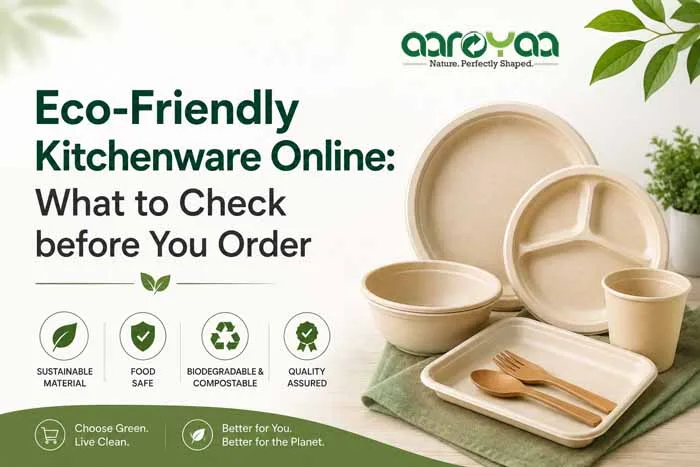
Buying eco-friendly kitchenware online looks simple until the cartons arrive. The trays are thinner than the photos suggested. The lids you ordered don't sit on the containers you ordered. And the price that felt cheap on the listing page turns out to be higher per meal than what you were paying before.
None of that is bad luck. It's what happens when you compare sellers on price alone, because price is the only number most listings make easy to compare.
This is a checklist, not a pitch. Six things to check before you place the order — whether you're a café owner switching from plastic, a caterer costing out a 400-plate function, or a home buyer who wants to buy biodegradable plates, India-made and be done with it. Work through these, and you'll order the right thing the first time.
The short version
If you only have two minutes, check these six:
- Certification — ask for the test report, not the word "eco-friendly"
- Thickness and weight — grams per piece and wall thickness, not vague adjectives
- Lid fit — confirm which lid goes with which container, by SKU
- MOQ and pack size — what you're actually committing to per order
- Shipping and damage policy — who pays if 40 pieces arrive crushed
- Per-piece cost — the real number, including the lid
The rest of this article explains what "good" looks like for each one.
1. Certification: ask for the paper, not the adjective
"Eco-friendly" is not a regulated term in India. Anyone can print it. "Biodegradable" and "compostable" mean specific, different things — and only one of them has a testing standard behind it.
The standard to know is IS/ISO 17088, the Indian specification for compostable products. Sellers who have had their material tested against it will have a lab report that includes a date, the laboratory name, and the product it covers. Many Indian sellers also hold a CPCB certificate for compostable products.
Here's what to actually ask, over WhatsApp or email, before ordering:
● Which standard was the material tested against, and when?
● Can you send the test report or certificate number?
● Does the report cover this product, or a different item in your range?
That last one catches more sellers than the first two. A test on one product doesn't automatically cover everything in a catalogue.
Also ask about food-contact safety separately. Compostability is about what happens after the meal. Food safety is about what happens during it. For anything that holds hot or oily food, ask whether the material has been tested for food contact and heavy-metal content.
If a seller can't answer these in a day or two, that tells you something useful before you've spent money.
Not sure what separates "biodegradable" from "compostable"? We covered the difference in plain language in our earlier post on what eco-friendly labels actually mean — worth ten minutes if you're buying for a business.
2. GSM, thickness and the number that actually matters
You'll see GSM quoted a lot. It's worth understanding what it does and doesn't tell you.
GSM (grams per square metre) is a paper measurement. It's the right number for paper cups, paper bags and tissue. It's genuinely useful there — a 250 GSM paper plate behaves very differently from a 180 GSM one.
Moulded bagasse and areca leaf products aren't flat sheets. They're pressed into a shape with varying wall thickness — thicker at the rim, thinner at the base. A single GSM figure doesn't describe them well.
So for moulded kitchenware, ask for two things instead:
● Weight per piece in grams. A 750 ml bagasse container is typically in the 20–30 g range. If a seller quotes noticeably less for the same volume, the walls are thinner. It will flex when someone picks up a full container of dal.
● Wall thickness in mm, or at minimum, a video of a filled container being lifted by one hand.
Weight per piece is the honest number. It's hard to fake and easy to verify — weigh five pieces on a kitchen scale when the order arrives and divide.
Why this matters more than it sounds: thin containers don't fail in the warehouse. They fail at the delivery rider's third stop, when gravy has softened the base and the whole thing sags. You don't find out from the listing. You find out from a customer complaint.
Ask about heat and moisture tolerance too. Most quality bagasse handles hot food, microwave reheating and freezer storage — but confirm it for the specific product rather than assuming. Gravy dishes, in particular, deserve a direct question.
3. Lid fit: the mistake that costs the most
This is the single most common ordering error, and it's entirely avoidable.
On most eco-friendly kitchenware sites, containers and lids are separate products. They have separate listings, separate prices and separate SKUs. It's easy to add 25 containers to the cart, feel finished, and discover on delivery day that you've bought 25 open bowls.
The second version of the mistake is subtler: buying a lid that exists, but doesn't fit your container. Two containers of identical volume can take completely different lids depending on shape. A 750 ml round container and a 750 ml square container hold the same amount of food and need entirely different lids.
Some fits are genuinely convenient once you know about them. In our kitchenware range, one lid covers both the 250 ml and 350 ml round containers — so two portion sizes share a single lid SKU. That's one less thing to stock and one less thing to run out of.
Before you check out:
● Match every container SKU to its lid SKU by name, not by volume
● Check quantities match — 25 containers need 25 lids, and pack sizes don't always align
● If the listing doesn't state the fit clearly, message the seller and get it in writing
Or skip the problem entirely. Clamshell boxes have a hinged lid built in. One SKU, one price, nothing to match. For takeaway and delivery, they're usually the simpler choice — and, as the next section shows, often the cheaper one too.
4. MOQ and pack size: know what you're committing to
Two different numbers, often confused.
Pack size is how the product ships — most bagasse kitchenware moves in packs of 25 or 50. MOQ (minimum order quantity) is the smallest order a seller will accept, and it's usually much higher for wholesale pricing.
For a home buyer or a small café, packs of 25 are the practical unit. You can test two or three formats without committing to a pallet, see which ones your customers handle well, then scale the winners.
For volume buyers, the real question isn't the MOQ number — it's what changes when you cross it:
● Does the per-piece price drop, and by how much?
● Does lead time get longer?
● Can you mix SKUs to reach the minimum, or must it be one product?
● Is there a repeat-order rate, or does every order start from scratch?
That last question matters most for anyone ordering monthly. If you're buying at any real volume, the bulk orders page is the right starting point rather than the retail cart — the pricing structure is different.
A practical suggestion: order small first. One pack of each format you're considering. Run them through a real service — actual gravy, actual delivery bags, actual customers. Then place the volume order. A ₹500 test is much cheaper than 5,000 pieces of the wrong tray.
5. Shipping and damage: the question nobody asks first
Moulded fibre kitchenware is sturdy in use and vulnerable in transit. It stacks and nests well, which is why it ships efficiently — but a crushed corner in a carton can flatten the rims of thirty pieces at once.
Before ordering, find out:
● What's the free shipping threshold? Many Indian sellers set it around ₹2,000. If you're at ₹1,700, adding one more pack often costs less than the shipping you'd otherwise pay.
● What happens if items arrive damaged? Ask about the window for reporting, and whether photo evidence is required.
● What's the return position on opened packs? Hygiene products usually can't be returned once opened, which is normal — but you should know it before, not after.
Read the shipping policy and refund policy pages before checkout, not after a problem. Two minutes now, versus an argument later.
When the delivery arrives: open and inspect the same day, even if you won't use the stock for a week. Most damage windows are short. Photograph the outer carton before you open it — if there's crush damage, that photo is your evidence.
6. Per-piece pricing math: the number that decides everything
Listing prices are shown per pack. Your actual cost is per meal served. Those are very different numbers, and the gap is where budgets quietly go wrong.
The formula is simple:
(Container price ÷ pieces per pack) + (Lid price ÷ pieces per pack) = true cost per serve
E. g,
750 ML Container - per piece price = 795/25 = 31.80
750 ML Container Lid - per piece price = 631.9/25 = 25.27
Per serve value = 31.80 + 25.27 = 57.07
Same portion size. A ₹12,900 difference across 500 meals — nearly half the budget — decided entirely by shape and whether the lid is separate.
This is why per-piece math is worth doing properly. The round container isn't a bad product; it's the right choice for some foods and some presentations. But if you chose it without running this calculation, you didn't actually choose it.
Three habits that keep this honest:
- Always cost the lid with the container. A container price without its lid is a fiction.
- Compare cost per serve, not cost per pack. Pack sizes differ between sellers; per-serve is the only fair comparison.
- Check the discounted price, not the struck-through one. Most listings show both. Only one of them is real.
Good sellers make this easy — many listings show a per-count price directly, so the math is done for you. If a seller only shows pack prices with no per-piece breakdown, divide yourself before comparing.
The pre-order checklist
Copy this. Run through it before you check out.
● Asked for the certification and received a dated test report
● Confirmed the report covers this specific product
● Asked about food-contact safety for hot and oily food
● Got weight per piece in grams (or thickness in mm)
● Matched every container SKU to its correct lid SKU
● Checked lid quantities match container quantities
● Confirmed pack size and MOQ
● Read the shipping threshold, damage window and return policy
● Calculated true cost per serve, including lids
● Ordered a small test batch before committing to volume
Ten checks. Maybe fifteen minutes. It's the difference between an order that works and an order you regret.
Before you order
You don't need to be an expert on moulded fibre to buy well. You need to ask six questions and do one piece of arithmetic. Sellers who welcome those questions are generally the ones who've done the work; sellers who deflect them are telling you something for free.
If you're ready to work through the list, browse the full eco-friendly kitchenware range — containers, clamshells, trays and matching lids, with per-piece prices shown on every listing so the math is already half done. For plates and bowls, the tableware collection is the place to start, and for cups and glasses, drinkware.
Still deciding between formats, or costing a large function? Get in touch — send your menu and headcount, and it's usually a ten-minute conversation to land on the right combination.
Aaroyaa is a women-led business based in Bhopal, making biodegradable tableware and kitchenware from sugarcane bagasse and areca palm leaf. Proudly made in India.
Frequently Asked Questions
Common questions related to this article.
What certification should I look for when buying eco-friendly kitchenware online in India?
Look for testing against IS/ISO 17088, the Indian standard for compostable products, and ask whether the seller holds a CPCB certificate. Request the actual report — it should carry a date, the testing laboratory's name, and the specific product covered. Ask separately about food-contact safety, since compostability testing and food-safety testing are different things. A seller who answers these clearly is usually a seller worth ordering from.
Do lids come with containers, or do I have to buy them separately?
On most sites, including ours, lids are sold as separate products with their own listings and prices. Always match the container SKU to its lid SKU by name — two containers of the same volume can need completely different lids if their shapes differ. If you'd rather avoid the matching entirely, choose clamshell boxes, which have a hinged lid built into the same piece.
Is it cheaper to buy biodegradable plates in India in bulk, or in small packs?
Bulk is cheaper per piece, but only worth it once you know which format actually suits your food and your customers. The sensible sequence is to order retail packs of 25 first, test them through a real service, then move the proven SKUs to a bulk order. Testing a few hundred rupees of stock is far cheaper than storing thousands of pieces you end up not using.