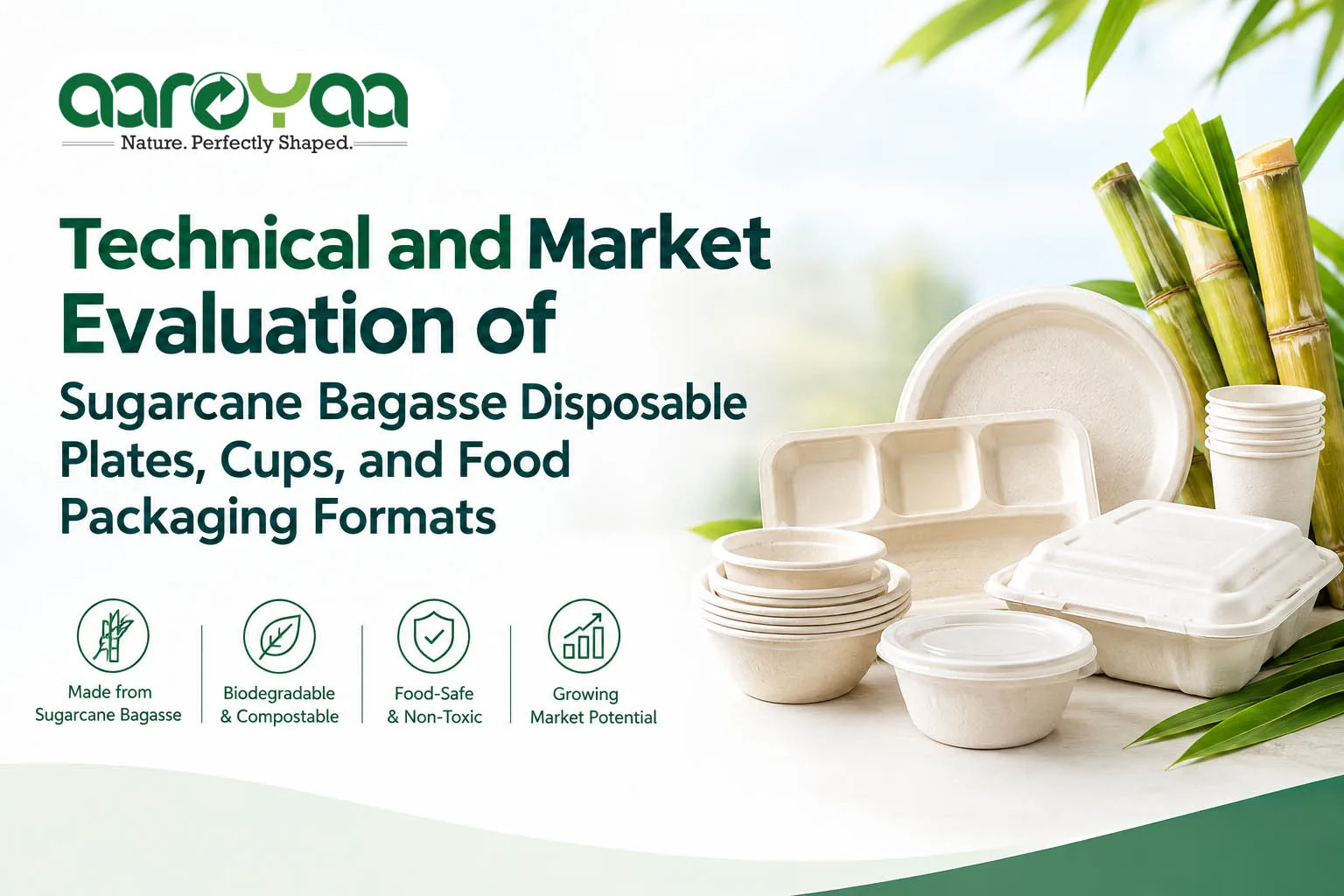
Technical and Market Evaluation of Sugarcane Bagasse Disposable Plates, Cups, and Food Packaging Formats
Industrial Transition in Single-Use Tableware and Bio-Based Materials
The global food service packaging sector is undergoing a structural transformation driven by statutory bans on single-use plastics (SUPs), escalating municipal solid waste fees, and heightened consumer demand for bio-based, circular alternatives. Historically dependent on expanded polystyrene (EPS) foam and synthetic polymers, the market for disposable plates, food plates, cups, bowls, and takeaway containers is rapidly shifting toward molded plant-fiber substrates. Among non-wood bio-resources, sugarcane bagasse has emerged as a premier agricultural residue capable of delivering mechanical strength, thermal endurance, and complete compostability without diverting land from food crop production.
Bagasse is the dry, fibrous residue remaining after sugarcane stalks are crushed to extract sucrose-rich juice during sugar refining. Generating hundreds of millions of tonnes annually across tropical and subtropical agricultural regions, this byproduct provides an abundant, scalable, and low-cost raw material stream. Utilizing bagasse for disposable plates, catering packaging, and drinking cup lids converts an agricultural waste stream—historically incinerated in mill boilers or sent to landfills—into high-value molded fiber tableware.
The industrial manufacture of bagasse plates and associated items requires specialized material science, mechanical pulping, thermoforming, and surface barrier engineering. Comparing bagasse against alternative bio-based materials like cornstarch-derived polylactic acid (PLA) and virgin wood-pulp kraft paper highlights distinct technical and economic tradeoffs across high-temperature food contact, oil resistance, and organic disposal recovery pathways.
Raw Material Dynamics, Chemical Properties, and Material Performance
Sugarcane bagasse consists primarily of three natural polymers: cellulose, hemicellulose, and lignin. The high concentration of long-chain cellulose fibers provides structural rigidity and tensile strength to finished food plates and containers, while hemicellulose promotes inter-fiber hydrogen bonding during wet pulping and pressing. Lignin acts as a natural structural binder, although its content is partially reduced or modified during refining to enhance sheet flexibility and whiteness.
Cellulose Content is 40% – 50%, which establishes mechanical wall strength and structural rigidity in molded plates. Hemicellulose Content is 25% – 35%, which facilitates inter-fiber hydrogen bonding during slurry formation. Lignin Content is 18% – 24%, which imparts natural rigidity, requiring controlled processing to balance flexibility. Mill-Exit Moisture Content is 45% – 52%, which demands immediate wet-pulping or drying prior to storage. The Natural Color Profile is Off-white to pale yellow, which requires mechanical refining or chlorine-free bleaching for high-whiteness applications. The Soil Biodegradation Period is 60 – 180 days, which assures environmental breakdown in natural soil without toxic microplastic residues. The Industrial Composting Timeline is ~90 days (EN 13432), which meets international standards for rapid industrial organic recovery.
The geographic distribution of bagasse availability corresponds directly with global sugarcane cultivation centers. Major sugar-producing nations—including Brazil, India, China, Thailand, and Pakistan—generate over 270 million tonnes of dry bagasse annually. In India, annual bagasse production exceeds 100 million tonnes across major growing regions such as Uttar Pradesh, Maharashtra, Karnataka, and Tamil Nadu. Co-locating molded fiber manufacturing plants near sugar mills reduces fiber transport distances, mitigating logistics emissions and lowering raw material input costs.
When evaluated against competing single-use substrates, bagasse demonstrates superior performance in heat tolerance and structural stability. Unlike cornstarch PLA, which softens at temperatures above 45°C to 60°C, bagasse plates maintain structural integrity under hot food applications up to 120°C and are microwave-safe. Compared to kraft paperboard, which relies on synthetic polyethylene (PE) or wax coatings to resist liquid penetration, bagasse can achieve fluid resistance through fiber refining or bio-based surface treatments.
Sugarcane Bagasse has a Thermal Limit of Up to 120°C (Microwave-safe), with High (via fiber density and PFAS-free additives) Fluid & Oil Barrier Mechanism, Home & Industrial Composting as its End-of-Life / Degradation Pathway, and its Primary Performance Advantage / Constraint is Agricultural byproduct; excellent hot food rigidity; zero arable land displacement.
Cornstarch (PLA) has a Thermal Limit of 40°C – 60°C, High natural oil resistance as its Fluid & Oil Barrier Mechanism, Industrial Composting only as its End-of-Life / Degradation Pathway, and its Primary Performance Advantage / Constraint is that it Warps under hot food contact; competes with agricultural food crops.
Kraft Paperboard has a Thermal Limit of 80°C – 100°C, Requires plastic/polyethylene (PE) coating as its Fluid & Oil Barrier Mechanism, Recyclable (if uncoated) or Landfill as its End-of-Life / Degradation Pathway, and its Primary Performance Advantage / Constraint is that it Requires virgin wood pulp; plastic linings impede commercial composting.
Expanded Polystyrene (EPS) has a Thermal Limit of Up to 80°C, High natural fluid barrier as its Fluid & Oil Barrier Mechanism, Non-biodegradable (Persistent landfill waste) as its End-of-Life / Degradation Pathway, and its Primary Performance Advantage / Constraint is Low cost; high thermal insulation; severe microplastic pollution risks.
Manufacturing Operations, Pulping, and Thermoforming Engineering
The industrial converting process transforms coarse sugarcane bagasse into dense, food-contact disposable plates, containers, and cup components through a continuous sequence of wet pulping, vacuum forming, high-temperature thermoforming, drying, trimming, and automated quality control.
Raw bagasse transported from sugar mills undergoes initial depithing and mechanical washing. The depithing phase separates short, non-fibrous pith cells from the longer cellulose fibers, as excessive pith degrades the structural strength and surface finish of molded plates. Rinsing removes residual sugars, dirt, and silica particles, preventing sugar caramelization and mold discoloration during high-temperature pressing.
The cleaned bagasse fibers enter mechanical hydra-pulpers where they are blended with recycled process water to form a uniform slurry. Disc refiners mechanically fibrillate the fibers, expanding their surface area to maximize inter-fiber hydrogen bonding. At this stage, functional additives are metered into the slurry, including wet-strength agents, retention aids, and food-grade fluorochemical-free water and oil repellents.
The refined slurry, maintained at controlled fiber-to-water concentrations, is transferred to automated molding stations. Precision metal dies featuring fine wire screens are submerged into or sprayed with the slurry. Vacuum suction pulls liquid through the screen, depositing a uniform mat of wet bagasse fibers across the mold surface to form the preliminary shape of a plate, bowl, or lid.
The wet pre-form is mechanically transferred into heated hydraulic or electric thermoforming presses operating at pressures exceeding 5 MPa and temperatures between 160°C and 200°C. Under simultaneous heat and pressure, residual water is rapidly vaporized while the dense fiber structure cures, yielding a rigid, smooth-surfaced plate or container within a cycle time of 20 to 40 seconds. Modern packaging plants employ electric servo-driven thermoformers, which reduce energy consumption per unit by up to 18% compared to conventional hydraulic systems.
After thermoforming, products are conveyed through drying and curing tunnels to eliminate residual moisture, preventing deformation or fungal growth during storage. Automated high-speed die-cutters trim perimeter flash from the molded plates and containers. The clean trim waste is routed back to the pulping system, minimizing material loss. Finally, products pass through automated optoelectronic vision systems to inspect edge consistency, surface smoothness, thickness uniformity, and structural integrity before undergoing food safety compliance checks and final packaging.
Global Market Analysis, Segment Dynamics, and Regional Demand Pathways
Driven by legislative restrictions on petroleum-based single-use items and the expansion of online food delivery networks, the global market for bagasse tableware and molded fiber packaging is expanding rapidly.
Global Bagasse Tableware (Broad Category) has a Base Year Value of USD 5.70 Billion (2024), a Forecast Value of USD 16.47 Billion, a Forecast Period of 2025 – 2035, and a CAGR (%) of 10.12%. Its Dominant Market Drivers are Global plastic bans; QSR conversion; expansion of delivery aggregators.
Global Bagasse Tableware (Focused Sector) has a Base Year Value of USD 1.20 Billion (2023), a Forecast Value of USD 2.80 Billion, a Forecast Period of 2023 – 2030, and a CAGR (%) of 12.50%. Its Dominant Market Drivers are Municipal EPS foam bans; commercial food service sustainability targets.
Global Molded Pulp Tableware Market has a Base Year Value of USD 6.21 Billion (2025), a Forecast Value of USD 10.13 Billion, a Forecast Period of 2026 – 2034, and a CAGR (%) of 6.30%. Its Dominant Market Drivers are Institutional catering adoption; rapid growth in cloud kitchens.
Indian Bagasse Tableware Market has a Base Year Value of USD 161.37 Million (2021), a Forecast Value of USD 365.21 Million, a Forecast Period of 2021 – 2030, and a CAGR (%) of 8.80%. Its Dominant Market Drivers are National plastic bans; domestic raw material availability.
South Korean Bagasse Tableware Market has a Base Year Value of USD 20.00 Million (2025), a Forecast Value of USD 36.80 Million, a Forecast Period of 2025 – 2035, and a CAGR (%) of 6.30%. Its Dominant Market Drivers are Commercial food service hygiene mandates; strict waste management laws.
Product segmentation reveals that disposable plates and food plates represent the largest single revenue category, accounting for 32.4% to 35.5% of overall market volume. Their structural rigidity, rim strength, and adaptability for hot, cold, liquid, and oily foods make bagasse plates the primary alternative to plastic and paper plates across commercial catering, corporate cafeterias, institutional dining, and outdoor events.
Takeaway lunch boxes, deep-draw bowls, and multi-compartment clamshell containers constitute approximately 42% of the pulp-molded packaging market. The surge in cloud kitchens and third-party meal delivery platforms has elevated demand for compartmentalized food plates and snap-fit hinged containers that maintain meal separation and prevent structural collapse during transport.
Drinking cups, cup lids, and paired cups-plates catering combos represent the fastest-growing product categories. While technical challenges in achieving tight liquid-seal tolerances historically slowed molded pulp adoption in beverage applications, advancements in precision thermoforming tools now enable bagasse cup lids and cold-drink cups to compete directly with polystyrene and polyethylene-coated paper alternatives. Commercial food service operations, including quick-service restaurant (QSR) chains and institutional caterers, account for 59% to 72% of total end-use volume.
Regionally, North America is the largest market by revenue, driven by aggressive state-level bans on single-use plastics in jurisdictions like California and New York, alongside corporate commitments to carbon neutrality. Europe represents a highly regulated market where the EU Single-Use Plastics Directive (Directive 2019/904) has effectively eliminated expanded polystyrene food containers, driving rapid adoption of EN 13432-certified compostable bagasse alternatives.
The Asia-Pacific region is the fastest-growing market for bagasse tableware. China serves as both a primary consumer market and the dominant manufacturing hub for molded fiber processing equipment and finished goods. India is expanding its production capacity by converting abundant domestic sugarcane bagasse into food-grade packaging to serve its domestic market following the 2022 implementation of national Single-Use Plastic Rules.
United States has a 2023 Estimated Valuation of USD 380 Million. Its Dominant Legislative & Commercial Market Drivers are Municipal plastic bans; corporate QSR sustainable packaging mandates. Its Target Certification & Food Contact Standards are FDA 21 CFR 176.170, ASTM D6400, BPI Certification.
European Union has a 2023 Estimated Valuation of USD 310 Million. Its Dominant Legislative & Commercial Market Drivers are SUP Directive 2019/904; mandatory eco-design and Extended Producer Responsibility laws. Its Target Certification & Food Contact Standards are EN 13432, EU Regulation 10/2011, TÜV Austria / DIN CERTCO.
China has a 2023 Estimated Valuation of USD 180 Million. Its Dominant Legislative & Commercial Market Drivers are National plastic restriction plans; massive food delivery and QSR market growth. Its Target Certification & Food Contact Standards are GB 4806.8 (National Food Safety Standard).
United Kingdom has a 2023 Estimated Valuation of USD 95 Million. Its Dominant Legislative & Commercial Market Drivers are Post-Brexit bans on single-use plastic plates, trays, and bowls. Its Target Certification & Food Contact Standards are EN 13432 compliance, UKCA food contact standards.
India has a 2023 Estimated Valuation of USD 55 Million – USD 161.37 Million. Its Dominant Legislative & Commercial Market Drivers are Single-Use Plastics Ban; 100M+ tonnes annual domestic bagasse supply. Its Target Certification & Food Contact Standards are FSSAI food contact regulations, BIS IS 17088.
Regulatory Frameworks, Barrier Chemistry, and PFAS-Free Innovations
Molded bagasse plates, cups, and food packaging must satisfy stringent international food safety standards before entering commercial supply chains. Because food plates directly contact hot, aqueous, and fatty substances, regulatory authorities enforce strict overall migration limits (OML) and specific migration limits (SML) to verify that chemical constituents do not leach into food.
Global regulatory compliance protocols include: United States: Products must meet FDA 21 CFR 176.170 and 176.180 regulations governing paper and paperboard components in contact with aqueous and fatty foods. Commercial compostability certification requires testing under ASTM D6400 or ASTM D6868 standards. European Union: Tableware must comply with Regulation (EC) No 1935/2004 on food contact materials and chemical safety testing under EU 10/2011. Industrial compostability requires certification under EN 13432. China: Products must fulfill GB 4806.8 national food safety standards for paper and fiber products. India: Compliance requires Food Safety and Standards Authority of India (FSSAI) clearance alongside Bureau of Indian Standards (BIS) parameters.
A major technical challenge facing the molded fiber packaging sector is the elimination of per- and polyfluoroalkyl substances (PFAS). Historically, short-chain fluorinated compounds were added during pulping to impart grease and oil resistance to bagasse plates and containers. Due to bioaccumulation, environmental persistence, and health concerns, legislative bodies across North America and Europe have enacted strict bans on intentionally added PFAS in food packaging.
To maintain oil resistance without fluorinated additives, material scientists have developed alternative barrier chemistry systems. These include internal sizing agents using alkyl ketene dimer (AKD) and alkenyl succinic anhydride (ASA) for water resistance, combined with bio-based polymeric coatings (such as modified starches, micro-fibrillated cellulose, and bio-polyesters) for oil resistance. Secondary aqueous dispersion spraying applies a thin, continuous barrier across thermoformed plate surfaces, providing grease resistance while preserving compostability.
Legacy Fluorinated Additives (PFAS) have High Grease / Oil Resistance and High (up to 120°C) Temperature Tolerance. Their Regulatory & Environmental Compliance is Subject to statutory bans; non-compliant in major export markets. Their Production Cost Impact is Baseline standard cost.
Bio-Based Polymeric Additives (Modified Starches/Cellulose) have Moderate to High Grease / Oil Resistance and Moderate (up to 100°C) Temperature Tolerance. Their Regulatory & Environmental Compliance is Fully compostable; non-toxic; compliant with international standards. Their Production Cost Impact is 10% – 20% cost premium over legacy systems.
Aqueous Dispersion Coatings have High Grease / Oil Resistance and High Temperature Tolerance. Their Regulatory & Environmental Compliance is Fully compostable; approved for direct food contact. Their Production Cost Impact is Moderate cost increase; requires secondary spray/drying steps.
Mechanical Fiber Micro-Refining has Moderate Grease / Oil Resistance and High Temperature Tolerance. Its Regulatory & Environmental Compliance is 100% natural cellulose; zero chemical additive requirements. Its Production Cost Impact is Higher mechanical energy input during pulping.
Life Cycle Assessment and Organic Recovery Pathways
Life Cycle Assessment (LCA) methodologies evaluate the environmental impacts of sugarcane bagasse plates and packaging across all life cycle stages: agricultural cultivation, raw fiber processing, pulp refining, thermoforming, regional distribution, consumer use, and ultimate organic recovery.
Because bagasse is a secondary agricultural byproduct, environmental impacts associated with sugarcane farming—such as irrigation, land preparation, and pesticide application—are allocated primarily to sucrose production. Consequently, the embodied carbon of raw bagasse entering a pulping plant is significantly lower than that of virgin wood pulp or fossil-based synthetic resins.
Research examining the Global Warming Potential (GWP) of bagasse tableware indicates that energy consumption during pulping, thermoforming, and oven drying constitutes the primary source of lifecycle carbon emissions. Operating thermoforming presses at 160°C to 200°C requires sustained thermal and electrical power. Life cycle modeling reveals a GWP footprint of approximately 30.93 kg CO₂ equivalent per unit measure for composite molded bagasse structures when relying on fossil-fuel power grids. However, when converters co-locate manufacturing facilities adjacent to sugar mills and utilize renewable bagasse biomass steam for power generation, net lifecycle carbon emissions decline substantially.
At end-of-life, unlaminated bagasse plates outperform persistent petroleum plastics like expanded polystyrene. Under industrial composting conditions specified by EN 13432 (58°C, high humidity, active microbial activity), bagasse tableware biodegrades into biogenic carbon dioxide, water, and organic soil amendments within 90 days, leaving no synthetic residues. In natural soil, decomposition completes within 60 to 180 days. Comparative LCA studies confirm that bagasse containers managed through commercial composting or anaerobic digestion yield lower overall environmental impacts across solid waste generation, marine ecotoxicity, and fossil resource depletion than legacy polystyrene foam packaging.
Strategic Outlook and Industrial Integration
The market trajectory for sugarcane bagasse disposable plates, food plates, cups, and eco-friendly catering tableware is defined by regulatory pressure, continuous manufacturing optimization, and advanced barrier technology integration.
Regulatory bans on single-use plastics will continue to drive food service operators, QSR chains, and institutional caterers toward molded bagasse formats. Economies of scale and technological refinements are systematically lowering production costs. The adoption of automated high-speed thermoforming machinery and servo-driven electric presses has reduced energy consumption per unit while increasing yield consistency. These manufacturing efficiencies have compressed the historical retail price premium of molded bagasse products relative to conventional plastics from 30%–40% down to 10%–15%, making eco-friendly disposable tableware accessible to price-sensitive emerging markets.
In response to strict environmental regulations, packaging producers are increasingly forming strategic joint ventures with sugar refiners to establish integrated co-location plants. By piping wet bagasse directly from sugar crushing lines into pulping units and utilizing surplus biomass energy to power thermoforming operations, integrated plants eliminate raw material drying and transport costs while reducing Scope 1 and Scope 2 carbon emissions. Concurrently, material science advances in PFAS-free aqueous dispersion coatings and micro-fibrillated cellulose barriers are enabling molded bagasse plates and liquid-tight cups to match the grease and moisture resistance of plastic-lined paperboard. As circular economy mandates tighten worldwide, sugarcane bagasse is established as a cornerstone substrate for high-performance, fully compostable food service packaging.
More stories from Aaroyaa
Eco-Friendly Disposable Plates: A Convenient Solution for Modern Living
The Math of Your Kitchen Roll: Why Switching to Eco-Friendly Tissue Adds Up