Lots of sustainable tableware products have green icons, and/or green boxes, and/or pretty ‘natural’ fonts, but not necessarily evidence to back up their claims.
At present, many products described as ‘sustainable’ may appear to be due to their branding; however, true sustainability could be occurring on farms, or in production, transport, or composting.
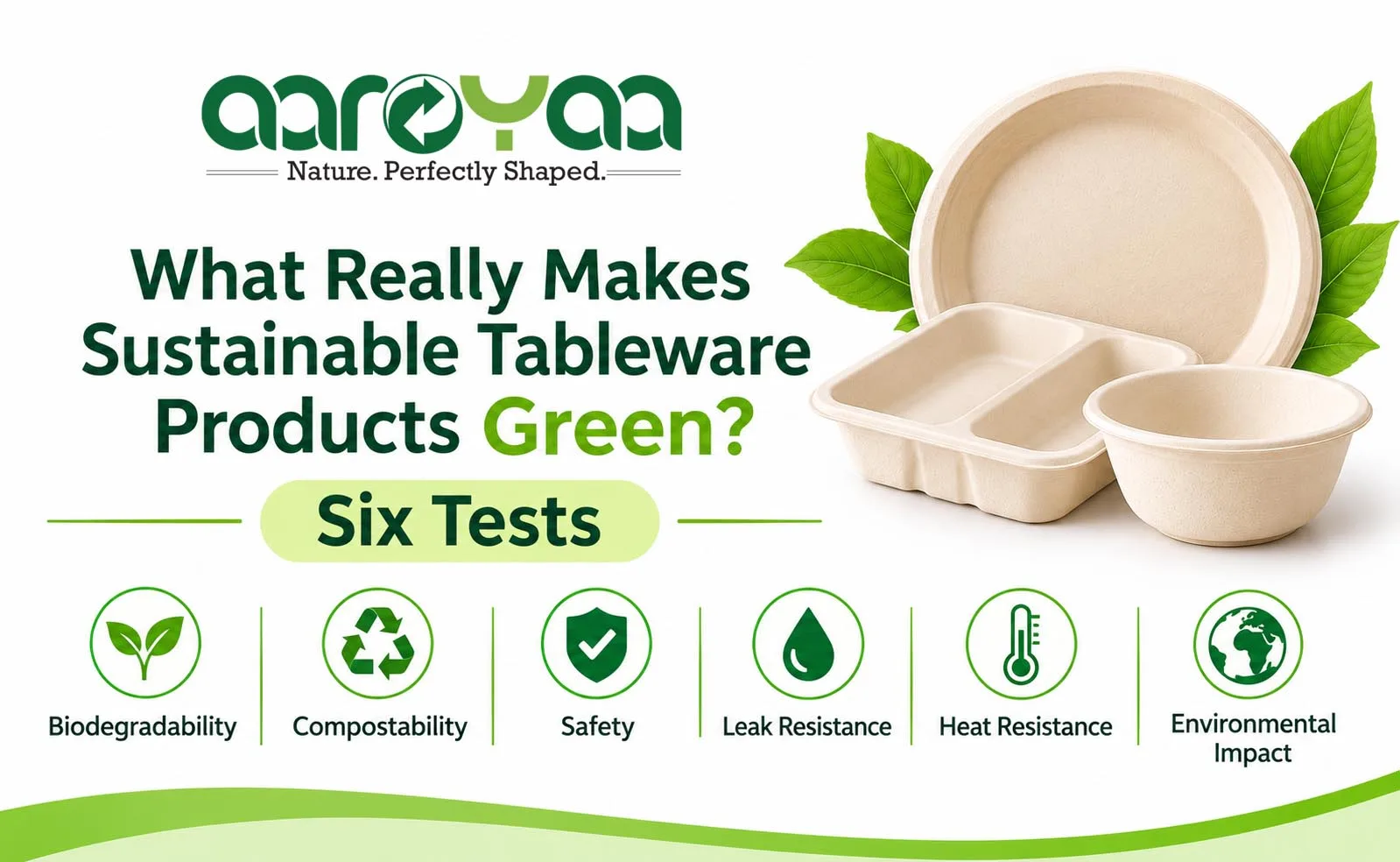
So here are six tests we think every product should pass. We make plant-fibre tableware ourselves at Aaroyaa, so yes, these apply to us too.
Test 1: What is it made from?
Ideally, it should be made from waste. Bagasse (leftover fibres from processing sugarcane to get juice and sugar) and fallen leaves from areca palm trees are both great choices. No land was cleared or crops grown specifically to make these.
Beware with bamboo and plant-based products. Sometimes, what looks like bamboo is actually bamboo powder mixed with melamine (plastic). If you can’t find out what material the product is made from, simply ask!
Test 2: How was it made?
In order to make plant fibre tableware more water- and oil-resistant, some companies add a coating. Some add PFAS – forever chemicals!
Studies in Europe have found that, in plant-based tableware, all moulded fibre plates and bowls had levels of PFAS and other worrying chemicals above recommended levels. In Australia, PFAS was found most frequently and at the highest levels in bagasse products.
However, in other studies, PFAS-free plant fibre packaging has been found. So it is possible to create sustainable tableware products without PFAS! Good sustainable tableware products should be able to prove this.
Simple question to ask: Is it PFAS-free? Can it provide evidence?
Test 3: What happens to it after use?
Make sure it does as it promises!
If it requires industrial composting to decompose, or has a thin layer of plastic in it, it may not fully biodegrade.
In India, the CPCB certificate and the S/ISO 17088 standard apply to compostable plastics. If you have plain bagasse, leaf or wooden tableware, it isn’t plastic. If a product (which is meant to be 100% plant-based) has a CPCB number, it likely contains a compostable plastic (like PLA) in it. This isn’t necessarily bad, but you should know.
Test 4: How far did it travel?
Plates that have travelled across oceans have already lost some sustainability points!
Where was the product made? As plates and bowls take up quite a bit of space (so you’re mostly shipping air!), ordering fewer, larger quantities will reduce the number of journeys made.
Test 5: Can they prove it?
A logo means nothing. Certifications will have numbers.
A legitimate certification will include the product name, the standard it was tested to, the testing laboratory, and the date. For biodegradable products, this may include EN 13432 or TÜV OK compost. If it’s just a badge on the homepage with no number, it’s for decoration.
Ask for evidence of the certification. Reputable suppliers will be able to provide it to you in 1-2 days. We can too!
Test 6: Who made it?
Many people neglect this question. If workers weren’t fairly paid or in safe conditions, then the plate can’t be said to be truly sustainable. Low prices can sometimes be misleading.
Our tableware is handmade by female artisans in India, and all orders support this work. Click here to meet our team.
Put the six tests to work.
Few products will score full marks on these questions, and that’s okay! However, products scoring 4/5 or 5/5 are much better than those scoring only 1/1 on labelling.
Next time you order tableware, try asking 2 of these questions. Ask what it’s made from, and whether it’s PFAS-free. How quickly and clearly they respond can give you some clues.
Get started with our range of sustainable tableware! We have plates, bowls, divided trays and wooden cutlery. All are made in India. Our 7-inch round plates (compostable) can be ordered in packs of 100. Currently on sale, this makes them around ₹4.80 per plate.
Order a pack and put them to the test! Decide for yourself.
Frequently Asked Questions
Common questions related to this article.
What is sustainable tableware?
Tableware, like plates, bowls and cutlery, made from renewable/waste resources, without harmful coatings, and can be safely broken down.
Are all compostable plates PFAS-free?
No, studies have found some moulded fibre plates (including bagasse) contain PFAS. Ask for evidence.
Should bagasse plates be certified by CPCB in India?
CPCB certification applies to compostable plastics. Plain bagasse is not a plastic, so it doesn’t require certification. If there is a plastic liner inside, this becomes a different case.
More stories from Aaroyaa
Can Sustainable Disposable Dinnerware Go in the Microwave or Freezer? (Complete Care & Safety Guide)
Biodegradable Food Containers vs Aluminium Foil: Which Is Better for Biryani and Curries?