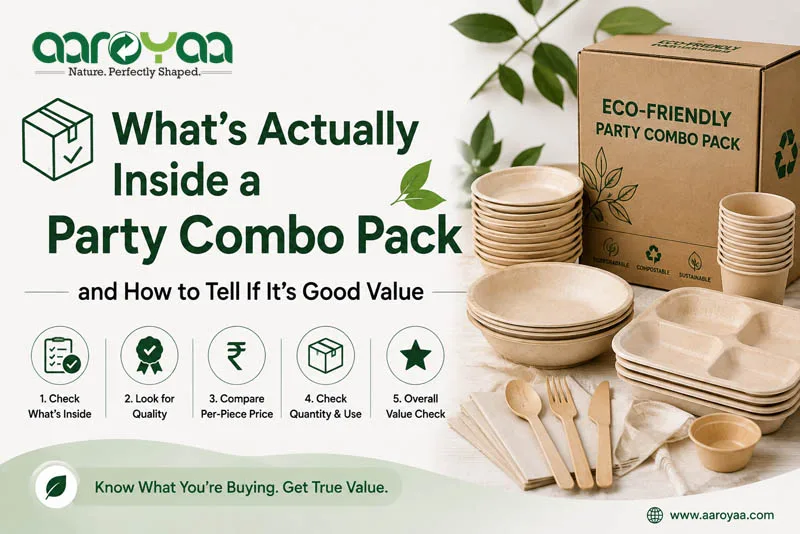
What's Actually Inside a Party Combo Pack — and How to Tell If It's Good Value
A combo pack is a very good deal or a very average one, and the listing will look identical either way.
That's the honest starting point. When you shop for eco-friendly tableware online, combos are the easiest thing to buy and the hardest thing to compare. Big piece counts. Half-price strikethroughs. A per-piece figure so low it stops feeling like a decision.
But the piece count is where combos hide their real cost. And once you know how to open one up, you'll never buy a bundle the lazy way again.
This will take you about five minutes to learn. It's ours to lose, honestly — some of what follows applies to our own combos as much as anyone's.
First, the number that misleads everyone
Almost every combo listing shows a "per count" price. Ours do too.
Here's the problem: that figure is usually calculated off packs, not pieces.
Take our Meal Serving Combo. The listing says ₹357.50, then underneath: PACK OF 6 • ₹59.58/count. Sixty rupees a count sounds steep for disposable tableware, and it would be — except the six isn't six plates. It's six packs. Two packs of bowls, two packs of trays, one pack of spoons, one pack of plates. Divide ₹357.50 by six, and you get ₹59.58.
The number is arithmetically correct and practically useless. Nobody serves a guest a pack.
You'll see the same thing across the shelf. One of our combos shows around ₹1.44 per count, another ₹140, another ₹54.43. Those products are not wildly different in value. The denominator just keeps changing.
So don't read that number. Do this instead:
- Read the item list in the product title. It's all there — quantities in brackets.
- Multiply out anything written as "2 pack of 10" or "3 pack of 25."
- Add them up. That's your real piece count.
- Divide the price by that number.
Four steps. It works on any seller's listing, not just ours.
Now do it on a real pack
Let's stay with the Meal Serving Combo, listed at ₹357.50 including taxes.
The title spells the contents out, which is what you want a listing to do. 180ml bowls, two packs of ten. Three-compartment meal trays, two packs of ten. Wooden spoons, a hundred of them. And 7-inch square plates, a pack of ten.
Multiply it out. Twenty bowls. Twenty trays. A hundred spoons. Ten plates.
One hundred and fifty pieces for ₹357.50 — about ₹2.38 each.
That's a far more honest figure than ₹59.58, and it sounds excellent. Now look at what those pieces actually are.
A hundred of the hundred and fifty are wooden spoons. Two-thirds of the pack, by count, is the cheapest item in it. The trays are the real workhorse here — three compartments, good for a full meal at a stall or an office lunch — and there are twenty of those.
Ten plates, though. Ten. Hold that number, because we'll come back to it.
What usually gets padded out — and why
This isn't a scandal. It's just how bundling works, and it's worth understanding rather than being annoyed about.
Spoons, forks, straws and tissue are cheap to make and cheap to ship. Plates, bowls and trays are not. So combo packs across the entire category — ours included — tend to be generous with cutlery and careful with the serving pieces.
The result is that piece count and value drift apart. A pack can be genuinely well priced and still be two-thirds cutlery.
You see the same pattern in our Serving Combo Pack at ₹381: thirty bowls, thirty 9-inch round plates, and again a hundred wooden spoons. A hundred and sixty pieces, about ₹2.38 each. Identical per-piece cost to the Meal Serving Combo — but a very different pack, because sixty of those pieces are things you'd put food on rather than eat with.
And our Complete Party Essentials Combo at ₹504 is honest about being entirely cutlery and straws. Three hundred and fifty pieces at roughly ₹1.44 each. Cheapest per-piece number on the page, precisely because there isn't a plate in it.
That's the whole lesson in three products. Per-piece cost mostly tells you what's inside the box, not how good the deal is.
The number that actually matters: cost per person served
Here's the better calculation, and it takes ten seconds.
Ignore cutlery. Count only the things food sits in or on — plates, bowls, trays, glasses, cups. Divide the price by that.
Run it again on the Meal Serving Combo. Fifty serving pieces out of a hundred and fifty. ₹357.50 divided by fifty is about ₹7.15 per serving piece, with the spoons effectively riding along.
The Serving Combo Pack has sixty serving pieces for ₹381 — about ₹6.35 each.
Our Chai Maggie Combo, at ₹420, holds fifty 350ml bowls and fifty tea cups alongside a hundred wooden forks. A hundred serving pieces, so around ₹4.20 each — which makes sense, because bowls and tea cups are smaller and lighter than dinner plates.
Now those three numbers mean something. They're comparable. They tell you what an evening of serving people actually costs.
Then ask: how many people does this feed?
This is where most combo regret comes from.
The Meal Serving Combo has ten square plates in it. If you're hosting fifteen people and each person takes one plate, you have run out of plates — regardless of the hundred and fifty pieces on the label.
So before you buy, count guests, not pieces:
● Sit-down meal — one plate per person, one bowl per person, one glass per person. No buffer, no second helpings on a fresh plate.
● Buffet or party — assume 1.3 plates per guest. People put a plate down, lose it, and take another. Every single time.
● Chai and snacks — cups run out fastest. Two cups per person across an evening is realistic, not generous.
● Kids' event — add 50% to everything and stop doing maths.
Match the pack's serving piece count to that figure. If the combo covers your guest list, the cutlery is a bonus. If it doesn't, the cutlery is padding.
When a combo genuinely wins
Having spent this long poking holes, let me be straight about where combos really do beat buying separately.
Shipping. One box, one charge. Ordering plates, bowls and spoons as three separate purchases can cost more in delivery than the difference in product price. If you clear the ₹2,499 free-shipping threshold on a single order, that gap widens further.
Not over-ordering. Buy items individually, and you'll end up with a hundred spoons and thirty plates anyway, because minimum pack sizes don't line up neatly. A combo has at least been sized as a set by someone who's thought about it.
One decision instead of six. Underrated. If the event is Saturday and it's Thursday, a combo that roughly fits is worth more than a perfect basket you assemble for forty minutes.
And where combos lose: ongoing commercial use. If you run a café or a cloud kitchen, you burn through one specific item — 350ml bowls, say — far faster than the rest. Combos will leave you with a drawer of spoons and no bowls. Buy your high-turnover SKU in bulk instead, and treat combos as a top-up. A proper bulk order conversation will beat any combo on per-piece cost once volume is involved.
The short version
Multiply out the brackets in the product title. Divide by serving pieces, not total pieces. Check the plate count against your guest count. Then compare.
Do that, and you'll be shopping for eco-friendly tableware online better than most people who sell it.
Where to start
If you're buying for a home, a birthday, a housewarming or a festival, the combo collection lists piece counts and item breakdowns on every product, so you can run all of the above before you pay. Do it. We'd rather you bought the right pack than the biggest one.
And if you're stocking a kitchen, café or venue, skip the combos and talk to us about bulk instead. That's a different conversation, and a cheaper one.
Frequently Asked Questions
Common questions related to this article.
Is the discounted price on combo listings real?
Treat strikethrough pricing as a signal, not a fact — across e-commerce generally, the "original" price is often a reference figure rather than a price anyone paid. The useful move is to ignore it entirely and judge the combo on its per-serving-piece cost. If that number is good against other listings, the discount label doesn't matter. If it isn't, no percentage on the badge will fix it.
How do I know if a combo has too much cutlery?
Rough rule: if more than half the piece count is spoons, forks, straws or tissue, the pack is cutlery-led. That's fine if you actually need cutlery — a party where people eat standing up genuinely does. It's not fine if you're hosting a sit-down dinner and need plates. Count the two groups separately before you decide, and be honest about which one your event is.
Is it cheaper to buy biodegradable plates India-wide as a combo or on their own?
For a one-off event, the combo usually wins once shipping is included, because you're consolidating four product categories into one delivery. For repeat use, single SKUs in larger quantities win on per-piece cost, and it isn't close at volume. The crossover point is roughly when you're reordering the same item monthly — at that stage, stop buying combos for that item and order it properly in bulk.