Which Bowl for Which Dish: A Simple Size Guide to Eco-Friendly Bagasse Bowls
Nobody wakes up wanting to buy bowls. You buy them because 40 people are coming on Sunday, there's dal, raita, and kheer to serve, and you'd rather not be scrubbing 120 steel katoris at midnight. So the real question isn't which bowl looks nicest. It's which size holds what you're actually serving.
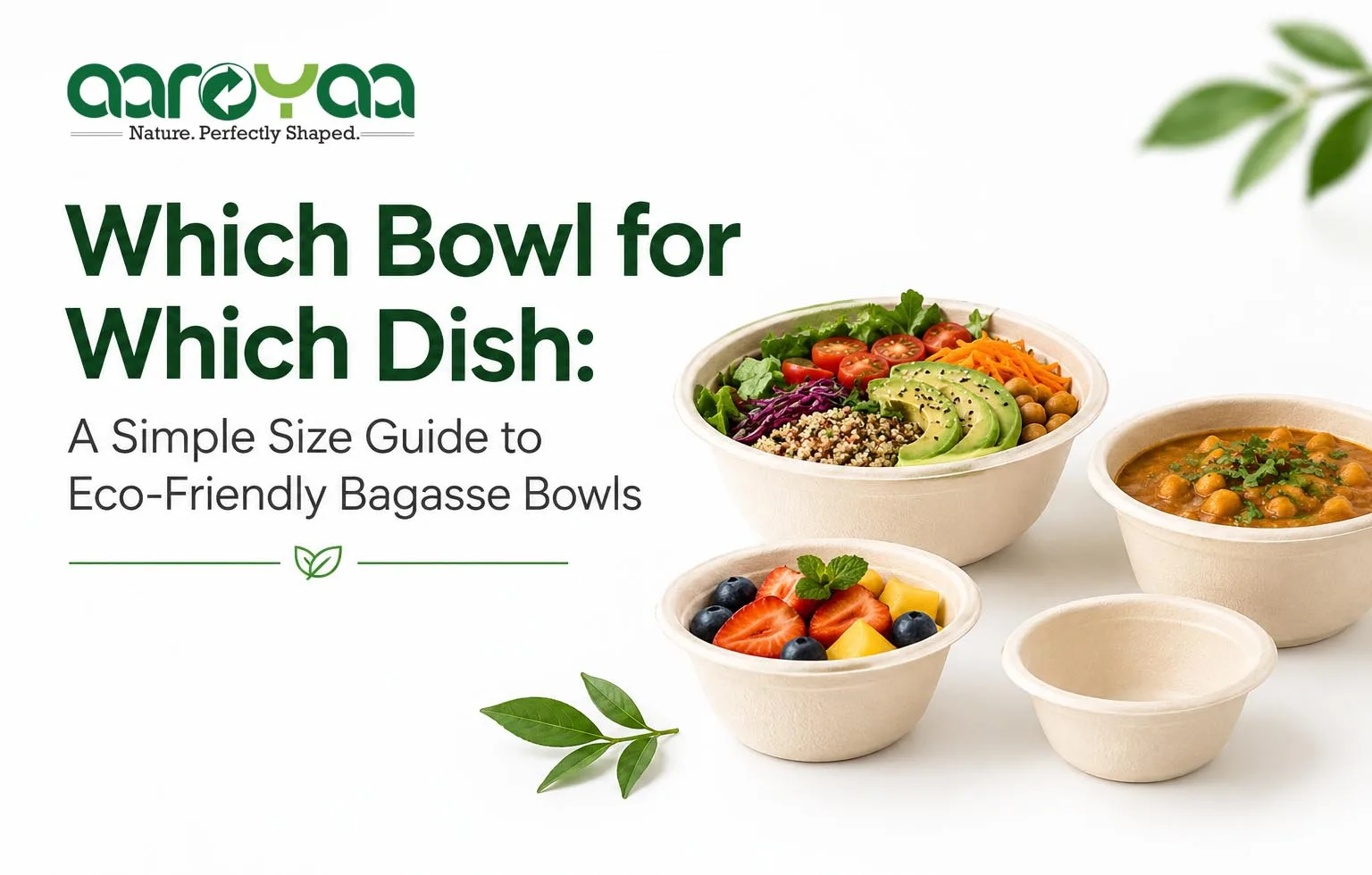
Here's how the sizes map to Indian food, using eco-friendly bagasse bowls — the ones pressed from sugarcane fibre left over after the juice is extracted.
Chutney, curd, raita and kheer: 120 ml to 150 ml
Start small. A 120 ml bowl is your chutney bowl, your pickle bowl, the one that takes a scoop of ice cream or two gulab jamuns. Buy the pack of 50, and it comes to ₹3 a bowl.
150 ml is where curd and raita belong. Enough for one person eating alongside a thali, not so much that it swims. There's also a dona-shaped 150 ml, and that's the one for prasad counters and chaat stalls — it's the leaf-cup shape everyone already knows how to hold.
Kheer, phirni, halwa? 150 ml is a proper serving. Go to 180 if you're feeling generous.
Dal and sabzi: 180 ml does most of the work
If you're only buying one size, make it this one. A 180 ml bowl takes dal, sabzi, rajma, chole, curd — the whole everyday middle of an Indian meal. It's listed at ₹3.84 a bowl.
There's a pack of 10 as well, at ₹3.90 a bowl. Almost the same price per piece, so unless you genuinely need ten, take the bigger pack.
One honest caution. Bagasse handles hot gravy well, but it does absorb some moisture over time. Ladle dal in at service, not an hour before. Plate too early and the base goes soft on you.
Chaat and soup: 240 ml and 350 ml
Chaat is messier than dal, and it needs room. Ragda patties, dahi puri, a bhel with three chutneys — 240 ml (₹4.08) lets someone actually mix it without wearing half of it.
350 ml is the soup size. It's also right for a curry travelling out with rice on a separate plate.
If soup is going into a delivery bag, you'll want the matching lid. Be warned: the 250/350 ml lid comes to around ₹7.68 per piece, which is more than the bowl. That changes your per-order maths, so factor it in before you quote. For dine-in, skip it.
Biryani and full meals: 750 ml and 1000 ml
Biryani will not fit in a 350 ml bowl. One generous portion needs the 750 ml bowl (₹14.40). A family portion, or a rice-and-curry meal in one container, wants 1000 ml (₹17.52). The burrito bowl at ₹19.68 is wider and shallower, which suits meal bowls where you want the layers on show.
Lids exist for all three, at ₹10.80, ₹12.24 and ₹18, respectively. For a wedding buffet where nothing travels more than ten feet, don't buy them. You'll be paying nearly the price of the bowl again for something that goes straight in the bin.
When these bowls aren't the right call
Daily family dinners. If it's four of you eating at home every night, steel is cheape,r and it lasts yearsEco-friendlyly bagasse bowls earn their keep when washing up is the actual problem — parties, catering, delivery, temple kitchens, office lunches, a house full of relatives in December.
That's the whole logic. Match the bowl to the dish, buy one size up when the gravy is thin, and you'll waste far less than you think.
Aaroyaa makes bagasse bowls from 120 ml through to 1000 ml, with lids for the sizes that travel, in pack sizes that suit both a home party and a catering order. Browse the bowls range or talk to the team about a bulk order.
Frequently Asked Questions
Common questions related to this article.
Can I put hot dal or soup directly into a bagasse bowl?
Yes. Bagasse handles hot food fine, and it doesn't warp or smell the way thin plastic does. What it doesn't love is sitting with wet food for a long stretch. Serve at the point of eating rather than plating up an hour ahead, and you won't see the base weaken.
Which size should I order for a mixed menu at a party?
Two sizes cover most gatherings. Take 180 ml for dal, sabzi and curd, and 150 ml for raita, chutney and dessert. Add 750 ml only if biryani or a full rice meal is going out in a single container.
Are eco-friendly bagasse bowls microwave-safe?
They hold up to short reheating, which is why cloud kitchens use them. They're not built for long oven cycles or repeated reheating. If a dish needs fifteen minutes of heat, move it to a dish first.