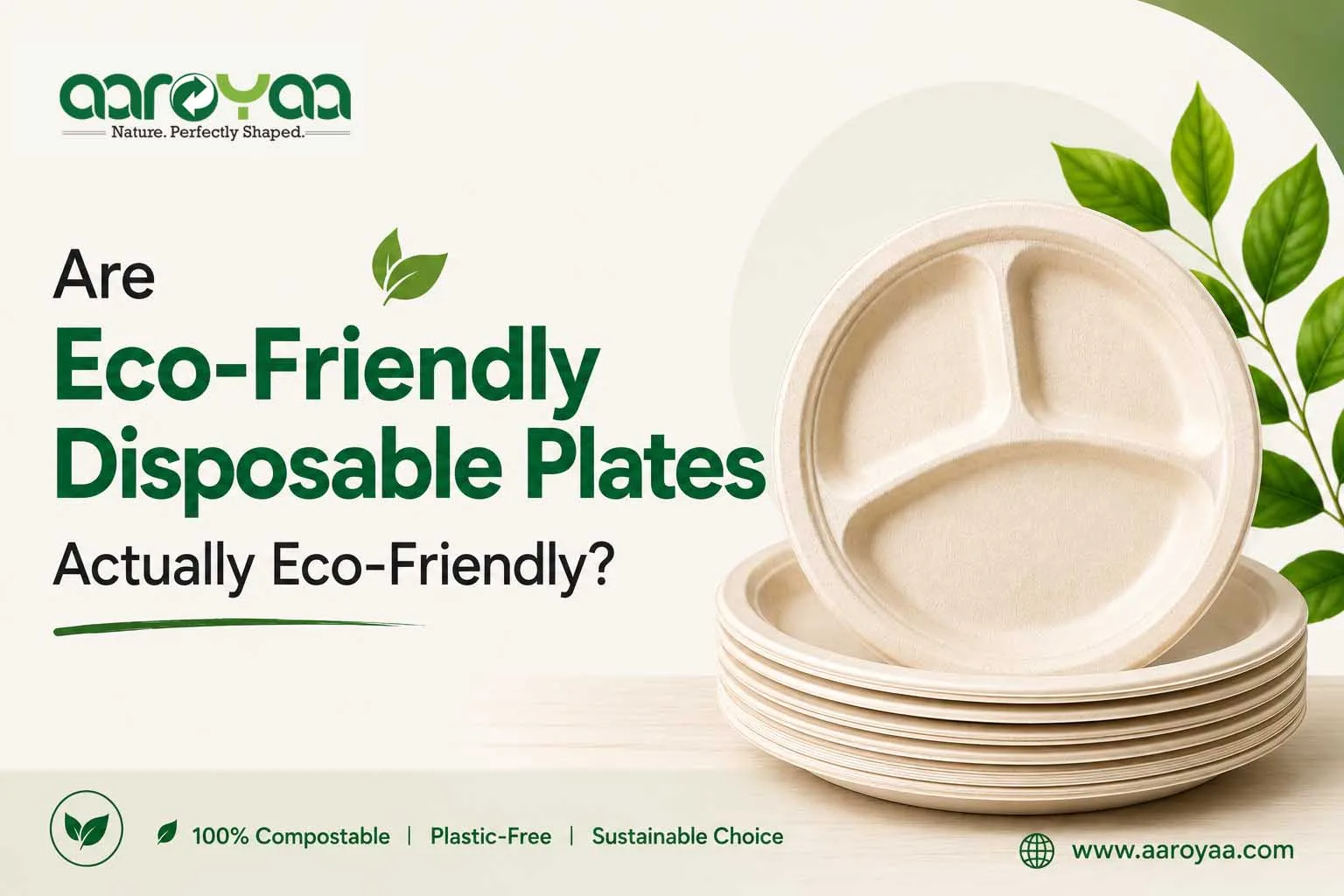
Are Eco-Friendly Disposable Plates Actually Eco-Friendly? What Biodegradable, Compostable and Bio-Based Really Mean
You have bought a packet of new environmentally friendly disposable plates. Their packaging carries a green leaf logo and the words "biodegradable". You smile to yourself, thinking how environmentally conscious you are.
Suddenly a small voice at the back of your head asks: Are they really? Is buying them just another way of paying more for the same old thing?
A very good question, and one that more people should be asking themselves nowadays.
Because here's the uncomfortable truth: some products sold as eco-friendly disposable plates genuinely break down into soil in a few months. Others are ordinary plastic with a plant-based additive, sold at a premium that will outlive all of us in a landfill.
Both sit on the same shelf. Both have green leaves on the box.
This article will help you differentiate between them. There is no sales-speak or scare tactics; we present a simple explanation of the differences between biodegradable, compostable, and bio-based products, and a short checklist that you can use the next time that you have to buy biodegradable plates in India. It will take you around six minutes to read this guide and save you thousands of rupees in expensive mistakes.
The short answer, before we go deeper
Some eco-friendly disposable plates are exactly what they claim. Many are not.
The label alone tells you almost nothing. What tells you something is the material, the certification, and the lining — and most brands mention only the first one, if that.
Now, let’s move on to the reasons why.
“Eco-friendly” is a weasel term; that’s why
That’s not to say that companies using those terms aren’t eco-friendly – they might well be, and the term itself isn’t necessarily a lie; the problem is that it doesn’t actually say anything.
See, in India, there is no legal definition for “eco-friendly”. Nobody is watching out for this term; there is no governing body to which you can complain if a company takes advantage of the term. And this goes for “green” and “natural” and those little leaf things at the bottom of the package. It’s all marketing mumbo-jumbo, a clever word designed to make you feel good about buying their product. But more often than not, there is no factual information hidden behind it.
That doesn't mean every brand using these words is dishonest. Plenty are completely genuine. It just means the words themselves carry zero information. You have to look past them.
Now, the terms “biodegradable”, “compostable” and “bio-based”, however, do say something.
The difference between biodegradable, compostable and bio-based
Biodegradable — technically true, practically vague
Biodegradable means that “organisms such as bacteria and fungi can partially decompose the material, rendering it unrecognisable.”
Notice the word eventually. There's no timeline attached. A newspaper is biodegradable. So is a wooden log. So, arguably, is a thick plastic bag over a few hundred years.
This is why "biodegradable" on its own is the weakest claim of the three. It's true of almost everything, and it promises nothing about how long or what's left behind.
Some "biodegradable plastic" is conventional plastic with additives that make it crumble faster. It doesn't disappear — it fragments into microplastics, which are arguably worse, because they're now small enough to enter soil, water and food. The EU restricted these oxo-degradable plastics for exactly this reason.
So when a pack says only "biodegradable" with no material named and no certification shown, treat it as a question, not an answer.
Compostable — the claim that actually means something
Compostable is biodegradable with rules attached.
To be genuinely compostable, a product must break down within a defined time, under defined conditions, and leave behind nothing toxic — just soil-safe organic matter. In India, the relevant standard is IS 17088, and compostable products are certified by the Central Pollution Control Board (CPCB). Internationally, you'll see EN 13432 or ASTM D6400.
There's one more distinction worth knowing, and it's the one that matters most in Indian homes:
● Industrially compostable means it needs a commercial facility with sustained high heat. Most Indian cities have very few of these. If your city doesn't have one, the plate goes to a landfill like everything else.
● Home compostable means it will break down in a normal backyard pit or compost bin, at ordinary temperatures.
This is where a lot of well-meaning purchases quietly fail. PLA cutlery, for example, is compostable — in an industrial facility. In a Bhopal backyard, it mostly just sits there.
Natural fibre plates made from sugarcane bagasse or areca palm leaf are different. They're plant matter to begin with, so they break down in home compost conditions, typically within 60 to 90 days when kept moist and mixed with other organic waste. That's the practical advantage, and it's a real one.
Bio-based — where it came from, not where it goes
Bio-based simply means the raw material comes from plants rather than petroleum.
That's it. It says nothing about how the product ends the story.
Bio-based polyethene made from sugarcane ethanol is a perfect example. It's plant-derived. It's also chemically identical to regular plastic, and it does not compost, ever.
So a product can be 100% bio-based and 0% compostable. Brands know this, and "made from plants" is a very easy phrase to lean on.
The sweet spot is a material that is bio-based and home compostable — where both the source and the destination are natural. Bagasse and areca leaf both sit in that category.
Three traps to watch for when buying eco-friendly disposable plates
- The hidden lining. A paper plate can be 90% paper and still be laminated with a thin plastic film to stop leaks. That film means the plate can't be composted or recycled. If a plate is glossy on the inside and the brand doesn't say what the coating is, ask.
- Certification that isn't shown. Genuine CPCB-certified compostable products have a certificate number. Brands that have one will usually show it. Vague phrases like "as per international norms" with nothing to verify are a soft signal.
- "Recycled" used to mean "compostable." These are different things. Recycled content is good, but a recycled plastic plate is still a plastic plate at the end of the meal. Read carefully — the two words get mixed up in product listings surprisingly often.
Where the plate ends up matters as much as what it's made of
Here's the part almost nobody mentions, and it's important enough that we'd rather say it than sell around it.
Even a perfectly compostable plate, if it's dumped in a mixed landfill, breaks down without oxygen and releases methane. It still avoids the microplastic problem, and it still avoids the fossil-fuel input — real wins. But it doesn't deliver the benefit you paid for.
The full benefit only arrives when the plate actually reaches soil.
So if you're going to buy biodegradable plates in India, plan the last step too:
● Segregate used plates with your wet waste, not your dry waste.
● Tear them into smaller pieces before composting — it speeds things up a lot.
● If you have a home compost bin, a terrace pot, or even a garden pit, use it. Food residue on the plate is fine; it's compost too.
● If your society has a wet-waste composting setup, these plates belong there.
We've written a longer, step-by-step guide on how to compost biodegradable plates, cups and containers in India if you want the practical detail.
The checklist: what to check before you buy biodegradable plates in India
Save this. It takes thirty seconds to run through, and it filters out most greenwashing.
- Is the material named? "Sugarcane bagasse" or "areca palm leaf" is an answer. "Eco material" is not.
- Home compostable or industrial? If it needs an industrial facility your city doesn't have, the benefit is theoretical.
- Is there a lining? A glossy inner surface with no explanation is worth a question.
- Is there a certification or standard mentioned? IS 17088, CPCB, ASTM D6400, EN 13432.
- Is it food-grade and chemical-free? This matters for you, not just the planet — especially with hot, oily Indian food.
- Will it actually hold a meal? A plate that bends under dal is not sustainable. You'll use two.
If a product clears all six, you're genuinely buying eco-friendly disposable plates. If it clears two, you're buying packaging design.
So — are eco-friendly disposable plates worth it?
Honest answer: yes, when they're the real thing, and when you're in a situation where disposables make sense anyway.
For a wedding with 300 guests, a temple bhandara, a café doing takeaway, or a birthday party at home — washing up isn't happening at that scale, and the choice isn't between disposable and reusable. It's between plastic disposable and compostable disposable. In that comparison, compostable wins clearly, on every measure.
For your everyday dinner at home? Steel and ceramic are still better. We'd rather say that plainly than pretend otherwise.
The goal was never to make disposables guilt-free. It was to make the unavoidable ones harmless.
That's the standard we hold ourselves to at Aaroyaa. Our tableware is made from sugarcane bagasse and areca palm leaf — no plastic, no chemical coating, food-grade, and home compostable in about 60–90 days. Every piece is crafted by our team of women artisans in India, which is the second half of why this business exists.
Ready to make the switch?
Now that you know what to look for, the test is easy: check the material, check the composting route, and check the coating.
Aaroyaa's plates, bowls, cups and cutlery are made from sugarcane bagasse and areca palm leaf, home compostable, food-grade, and strong enough for a full Indian thali.
Planning an event, running a café, or supplying a canteen? Our bulk orders programme offers volume pricing and custom-branded packaging.
Frequently Asked Questions
Common questions related to this article.
Are all eco-friendly disposable plates compostable?
No, and this is the single most common misunderstanding. "Eco-friendly" is an unregulated marketing term, while "compostable" is a defined standard. A plate can be marketed as eco-friendly and still be plastic-lined paper or bio-based plastic that never composts. Look for a named natural material such as bagasse or areca leaf, and check whether it's home-compostable or only industrially compostable before you buy biodegradable plates in India.
How long do bagasse and areca leaf plates take to break down?
Under normal home composting conditions — moist, mixed with other organic waste, reasonable airflow — bagasse and areca leaf tableware typically breaks down in around 60 to 90 days. Tearing the plates into smaller pieces speeds this up noticeably. If they end up in a dry landfill instead, decomposition takes considerably longer, which is why segregating them with wet waste genuinely matters.
Are biodegradable plates safe for hot and oily Indian food?
Good quality ones are. Bagasse and areca leaf tableware is naturally heat-resistant, holds hot curries, sambar and gravies without leaking or softening, and doesn't need a plastic lining to do it. Since there's no chemical coating, nothing leaches into hot food either. Do check that the brand states its products are food-grade — with hot, oily food, this is worth confirming rather than assuming.