Bagasse vs Areca Leaf vs Paper vs Thermocol: Which Disposable Plate Should You Actually Buy?
You are faced with four options, all of which carry food worth approximately a rupee to twenty rupees on a plate.
The cheap ones look nice, and the expensive ones look better. Besides, no one is going to tell you the differences, and the packing doesn't exactly give honest information either.
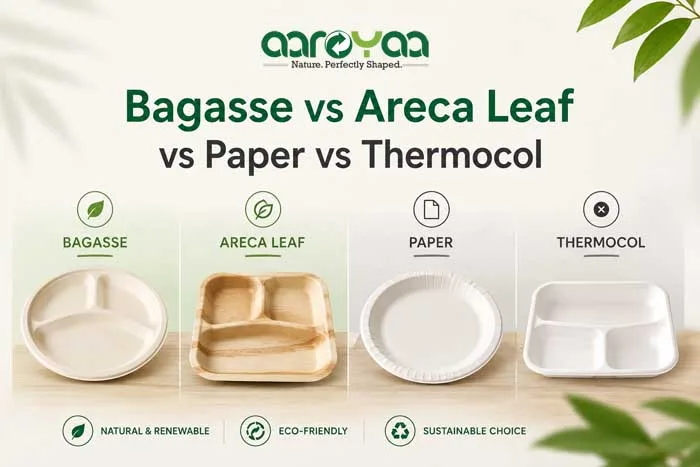
So here we go, an honest-to-god comparison of the four materials you can find in Indian biodegradable plates as of the writing of this article - natural bagasse, areca palm leaves, paper, and thermocol.
What they are made of, their properties regarding Indian food, their price, and where they end up.
By the end of this article, you will know precisely which one to buy depending on your situation, and which to avoid completely.
The quick answer
If you want the one-line version:
● Bagasse — best all-rounder. Handles gravy, hot food and daily use. The default choice for most people.
● Areca leaf — best for events and anything where the plate is seen. Stronger and more premium-looking, costs a little more.
● Paper — fine for dry snacks only. Most versions are plastic-lined, which quietly cancels the eco benefit.
● Thermocol — skip it. It's banned under India's single-use plastic rules, and it's the worst option for hot food.
Now the detail behind each of those calls.
The four materials, explained simply.
Sugarcane bagasse
Bagasse is the fibre left over after sugarcane is crushed for juice. It used to be burnt as waste. Now it gets pulped, moulded under heat and pressure, and turned into plates and bowls.
That origin story matters: this is a by-product. No extra land, no extra crop, no extra water — the sugarcane was already being grown.
What it's like to use: smooth, slightly matte, sturdy. It holds hot rice, dal, sambar and oily curries without going soft or leaking. Most bagasse tableware is microwave-safe and oven-safe up to around 200°C. It doesn't taste of anything, which sounds obvious until you've eaten off a cheap paper plate.
Where it ends up: home compostable, typically in 60–90 days in a normal compost pit or bin.
Areca palm leaf
Areca plates are made from the leaf sheath of the areca palm — the part that falls off the tree naturally. It's collected, washed, and heat-pressed into shape.
There's no pulping, no binder, no adhesive, no coating. It's a single piece of leaf, pressed. That's the whole process.
What it's like to use: noticeably rigid — these are the strongest of the four by a comfortable margin. Each plate has its own grain pattern, so no two look identical, and the natural wood-like finish photographs beautifully. This is why caterers and wedding planners keep coming back to them.
Where it ends up: home compostable, similar timeline to bagasse.
One honest limitation: because it's a pressed natural leaf rather than a moulded pulp, areca is at its best with food served and eaten within a normal meal window. Leave a very watery dish sitting in one for several hours, and the leaf will eventually soften. In practice this rarely comes up — but you asked for honest.
Paper plates
Here's where it gets murky, because "paper plate" describes two completely different products.
Uncoated paper plates are genuinely just paper. They're also nearly useless for Indian food. Any gravy, any oil, and they go soft within minutes. Fine for a samosa or a slice of cake.
Coated paper plates — which is most of what's sold — have a thin polyethene or wax film on the eating surface to stop leaks. That film works. It also means the plate is neither compostable nor recyclable, because you can't separate the plastic from the paper at any normal facility.
If the inside of a paper plate is glossy, assume it's lined until the brand tells you otherwise.
Where it ends up: uncoated, compostable. Coated, landfill.
Thermocol (polystyrene)
Thermocol plates are expanded polystyrene — the same material as packing foam. They're the cheapest option on the shelf, and that's the only thing they have going for them.
Three problems, in order of seriousness.
It's banned. Polystyrene and expanded polystyrene single-use items, including plates and cups, fall under India's single-use plastic ban that took effect on 1 July 2022. If you're a business, using them is a compliance risk, not just an ethical one.
Hot, oily food is the worst case for it. Styrene can migrate from the material into food, and that migration increases with heat and fat content. Which describes most of what gets served on a plate in India.
It never goes away. Thermocol doesn't biodegrade. It breaks into small white beads that blow around, wash into drains, and stay in the environment indefinitely. Anyone who has cleaned up after a function knows exactly what this looks like.
There's no scenario in this article where thermocol is the right answer.
The comparison table
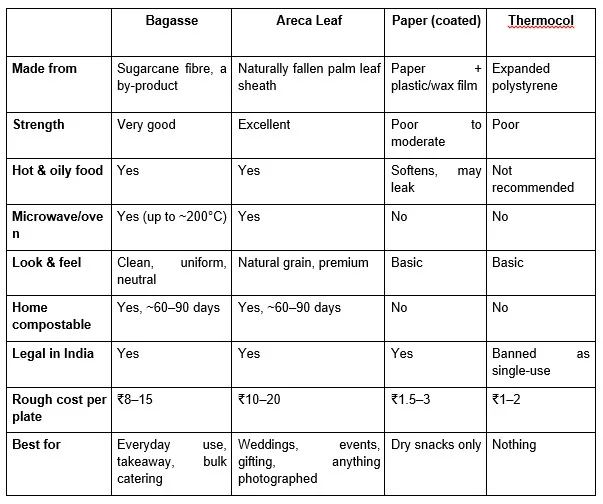
Prices are typical retail ranges and vary with plate size and order quantity. Bulk pricing brings t``he natural-fibre options down considerably.
Which one should you buy? Pick your situation
The right plate depends less on the material and more on what's happening at your table.
● Wedding, reception or large function → Areca leaf. The plates are visible in every photograph; they're rigid enough that guests can eat standing up without the plate folding, and they hold a full meal without help.
● Café, cloud kitchen or takeaway → Bagasse. It's designed for exactly this: hot food, sealed containers, gravy that has to survive a delivery ride.
● Home party, birthday, house function → Bagasse. Right balance of cost and performance for 20–40 people, and it goes straight into your wet waste afterwards.
● Temple bhandara, langar, community meal → Bagasse, in bulk. Volume pricing narrows the gap with paper significantly, and you avoid leaving a mountain of plastic-lined waste behind.
● Office pantry, tea and biscuits → Paper is genuinely acceptable here, since nothing wet is involved. Just buy the uncoated kind.
● Anything at all → Not thermocol.
The cost question, answered honestly.
Yes, natural-fibre plates cost more per piece. There's no point pretending otherwise.
But compare it against the right number. A thermocol or thin paper plate often needs doubling up when the food is heavy — people instinctively take two. So a ₹2 plate becomes ₹4, and it still bends.
And for a party of 25, the real difference between the cheapest option and proper eco-friendly disposable plates works out to a few hundred rupees. On an event where you've already spent thousands on food, that's a small line item for something every guest touches and notices.
Bulk buying closes the gap further. If you're ordering for a business or a large function, per-plate pricing drops meaningfully — it's worth asking for a quote rather than going by retail rates.
Before you buy: three quick checks
Whichever material you choose, run these:
- Is the material actually named on the pack? "Sugarcane bagasse" or "areca palm leaf" is information. "Eco-friendly material" is not.
- Is there a coating? A glossy inner surface on a paper-based plate usually means plastic. Ask if it isn't stated.
- Is it food-grade? This matters most with hot, oily food. A brand that's confident about it will say so plainly.
If you want the longer version of this, we've written a full guide on what biodegradable, compostable and bio-based actually mean — worth reading once before your next bulk order.
Making the switch
If you've read this far, you already know more than most buyers do. The decision is simple from here: bagasse for everyday and volume, or when it needs to look as good as it performs.
Aaroyaa makes bagasse. Food-grade, no plastic, no chemical coating, home compostable, and crafted by our team of women artisans in India.
Ordering for a wedding, café, canteen or event? Our bulk orders programme offers volume pricing and custom branded packaging — worth a conversation before you finalise.
From nature, back to nature.
Frequently Asked Questions
Common questions related to this article.
Which is better: bagasse or areca leaf plates?
Both are excellent, and the choice comes down to use rather than quality. Bagasse is the better everyday option — smooth, consistent, well suited to gravy-heavy meals and takeaway, and slightly more affordable. Areca leaf is stronger and has a distinctive natural grain that looks far more premium, which makes it the better pick for weddings, catered events and anything being photographed. Both are home compostable in roughly 60–90 days, so neither has an environmental advantage over the other.
Are paper plates eco-friendly?
Only if they're uncoated, and most sold in India aren't. The thin plastic or wax lining that stops paper plates from leaking also makes them impossible to compost or recycle, because the two layers can't be separated. An uncoated paper plate is genuinely compostable but goes soggy with any wet or oily food. If you need a plate that handles a real meal and composts, bagasse or areca leaf are the practical options when you buy biodegradable plates in India.
Are thermocol plates banned in India?
Yes. Expanded polystyrene single-use items, including plates and cups, are covered by the single-use plastic ban that came into force on 1 July 2022, which restricts their manufacture, sale and use. Beyond the legal position, thermocol is a poor choice for hot and oily food because styrene can migrate into it, and the material never breaks down — it just fragments into small beads that persist in the environment.