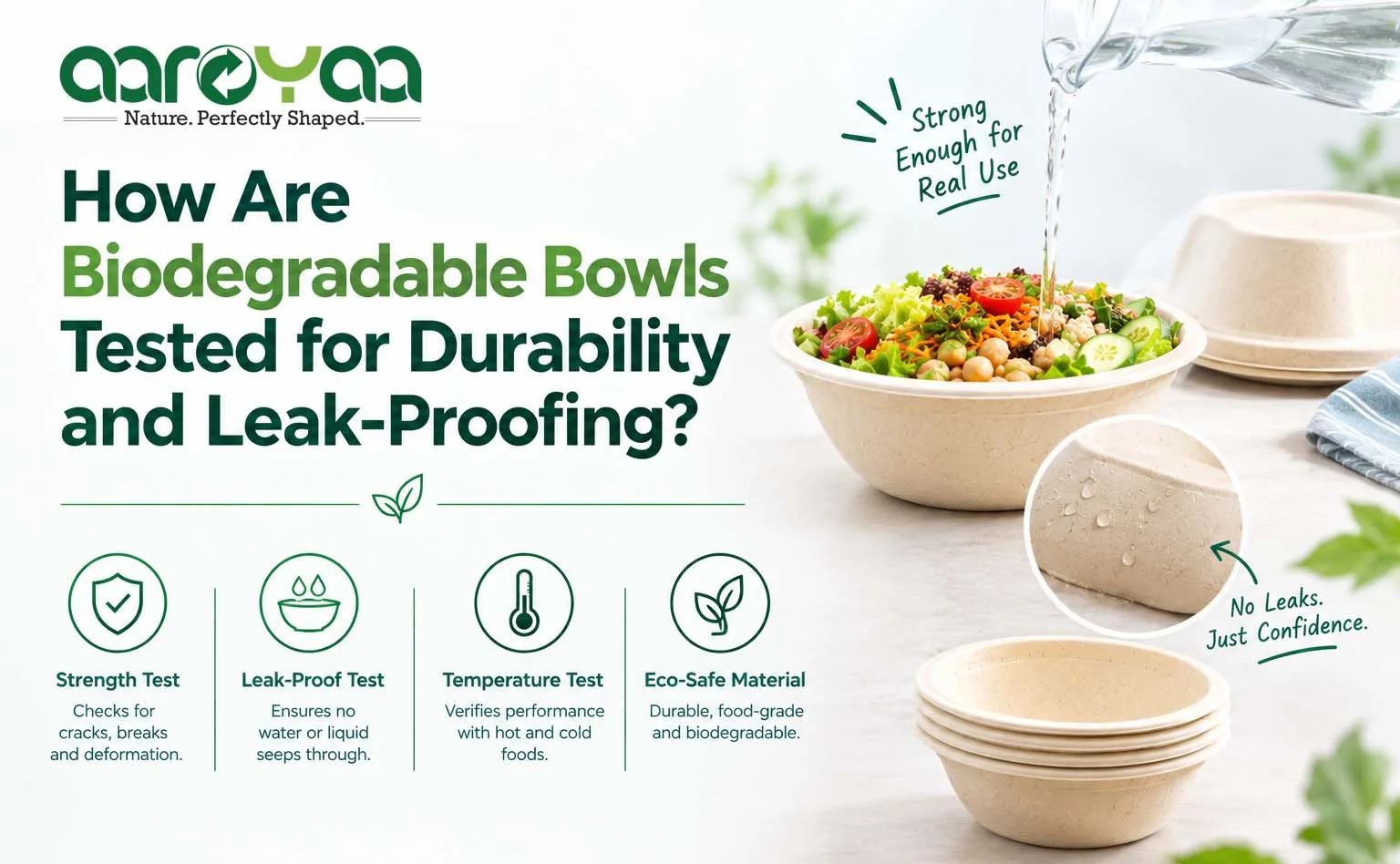
How Are Biodegradable Bowls Tested for Durability and Leak-Proofing?
A bowl of hot, steaming dal is placed on the dining table. The person picking it up pauses for a moment or two to chat before returning to his meal. However, for a biodegradable bowl, this could be a near-disaster situation, as it requires just the right amount of pressure and heat to hold its contents.
A practical test goes far beyond filling the bowl for a picture session as it captures all the details that went into the container and the time spent with them and the temperature they were subjected to.
Testing a biodegradable bowl for its quality, durability, and leak-proof features is not an easy task if one has fifty guests to cater for.
A real test goes beyond filling the item for a picture session. It considers every detail that goes into the product and the time it spends there, as well as the temperature.
What does testing biodegradable bowls actually involve?
Here, we’re focusing on moulded plant-fibre bowls, such as bagasse bowls. Other materials may require different methods.
Published inspection procedures for moulded-pulp tableware include appearance checks, resistance to hot water and oil, and bowl compression testing. These appear, for example, in Chongqing’s published inspection programme, which references the Chinese standard GB/T 36787-2018.
These procedures illustrate how performance can be assessed. They don’t establish test results for Aaroyaa’s products; those would require product-specific reports.
First, look for visible problems.
Before any dramatic pressure test, there’s a simpler question: does the sample have obvious defects?
For your own sample order, look for cracks, damaged rims and an uneven base. Place each bowl on a flat surface and check whether it sits steadily.
A neat finish is useful, but appearance alone cannot establish strength or leak resistance. That needs a closer look under controlled conditions.
The hot-water test: temperature and time count
One published procedure referencing GB/T 36787-2018 describes placing the sample on dry glass or a flat surface lined with filter paper. It is filled with water at 95°C, with a tolerance of 5°C, and left for 30 minutes.
The sample is then checked for deformation, seepage and leakage at the bottom.
That gives “leak-resistant” a specific context. A quick splash of room-temperature water tells you much less about a bowl intended for hot food.
Still, a successful 30-minute test doesn’t demonstrate performance for several hours. Nor does it automatically establish microwave suitability. Always match the evidence to the intended use.
Why oil gets a separate check
Water is only a part of the story for bowls that will see the menu include curry or a fatty gravy.
The same published protocol includes a test using edible oil at 95C +/-5C for 30 minutes, looking for deformation and oil stains on the filter paper support. This checks resistance to oil under the specified conditions.
These are both lab tests, and mostly for good reason, when it comes to hot oil. For a real-world serving test, use the food you're planning to use with the bowl within the parameters the supplier states.
Testing compression resistance tells us how much squeezing the bowl can handle.
Squeezing a bowl between your fingers gives an impression. A compression test provides measurements.
A manual compression test gives a good impression of the product's performance. A formal test uses a compression-testing machine, which applies force with plates or other fixtures while measuring the force and deformation. Testing-equipment supplier ZwickRoell offers instructions on how to set up tests that go up to a defined force or stop at a particular point when the machine reaches defined movement or failure.
Ask about the test conditions for biodegradable bowls. For example, was the compression resistance tested in dry bowls or after exposure to food or other liquids?
Pressing an empty bowl also cannot establish how a filled bowl and lid will behave during a delivery journey. That is a different use case.
Read beyond the word “passed”
A useful report should let you identify:
● The exact bowl model and capacity tested.
● The number of samples and the test date.
● The temperature, duration and loading conditions.
● The acceptance criteria and recorded results.
Leak resistance, food-contact suitability and biodegradability answer different questions. Evidence for one should not be treated as proof of all three.
Choose a bowl around your menu.
Aaroyaa’s bagasse bowl collection includes smaller serving bowls and larger meal sizes. Its 750 ml bowl is described as suitable for foods including curries, rice bowls and noodles.
Before a large order, ask for relevant test information and try a small pack with your actual portions and serving time. Check the underside afterwards, observe any softening and photograph the results with the elapsed time noted.
That trial complements formal evidence; it helps you judge everyday handling.
Ready to choose biodegradable bowls for your next gathering or food service? Browse Aaroyaa’s range, shortlist the right capacity and check its suitability before ordering in quantity. You’ll have a clearer reason for your choice—and one less uncertainty when the food is served.
More stories from Aaroyaa
Eco-Friendly Disposable Plates Manufacturing Process: From Sugarcane Bagasse to Sustainable Tableware

7 Table-Setting Ideas Using Eco Disposable Tableware