
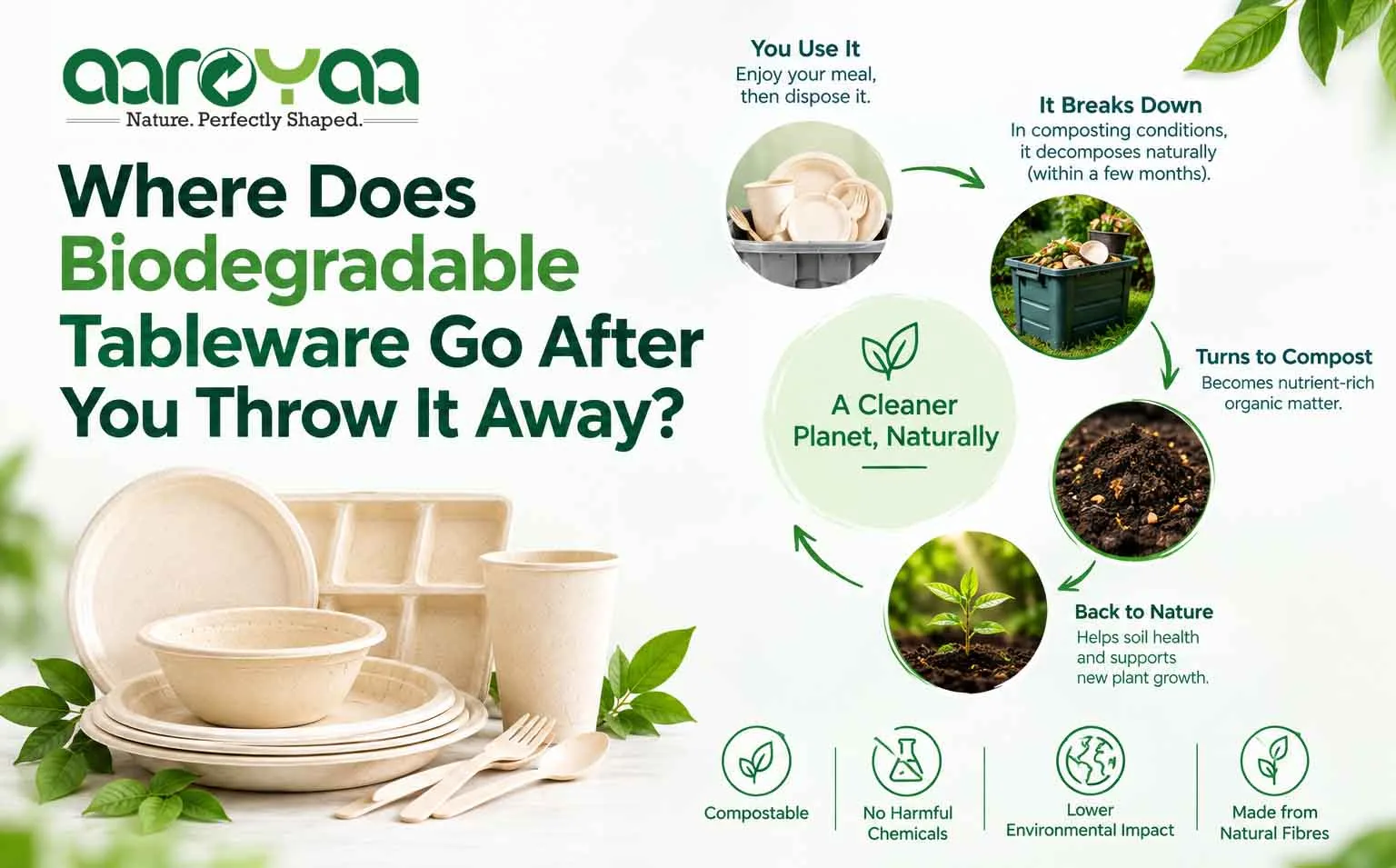
The last guest has left. There’s a little chutney on a plate, a few crumbs beside it, and a bin waiting under the kitchen counter.
You bought biodegradable tableware to make a better choice. But once that plate leaves your hand, what actually happens to it?
It depends on where it lands. The same plate can enter a composting system, get buried in mixed rubbish, or be rejected from a recycling facility. Its material matters. So does its destination.
Let’s follow it beyond the dinner table.
Biodegradable Tableware: One Plate, Different Endings
Picture a used plant-fibre plate at the moment you clear the table. Here are four possible journeys:
● Accepted compost collection → managed composting → finished compost
● Mixed rubbish → landfill → uncertain breakdown, with possible methane emissions
● Recycling bin → sorting → possible rejection
● Left outdoors → litter → unpredictable decomposition
“Biodegradable” describes a material’s ability to break down through biological activity. It doesn’t promise that this will happen quickly wherever you leave it. Conditions matter, particularly for biodegradable plastics, as the European Environment Agency explains.
That small distinction changes the whole story.
Route 1: The Plate Reaches a Composting Facility
Let’s give our plate a promising start. It’s suitable for composting, the local operator accepts it, and it arrives separately from mixed rubbish.
Inside the composting system, microorganisms get to work. With the right moisture, oxygen, and temperature, organic material breaks down. After processing and maturation, the finished compost can help improve soil.
There’s a catch: a compostable label doesn’t guarantee local acceptance. Facilities differ in what they can process. Your food-waste collector may accept scraps but exclude tableware. The EPA’s composting guidance makes this distinction clear.
And a garden compost heap? That’s another environment again. An industrially compostable product may need conditions your garden cannot provide. Check the finished product’s instructions for home-composting suitability.
Route 2: It Goes Out With Mixed Rubbish
Now rewind. The same plate goes into a bag with wrappers and other household waste.
If that bag reaches a landfill, the plate hasn’t arrived at a giant compost heap. It’s entered a different system, where buried waste can become deprived of oxygen.
When organic material decomposes under these conditions, it can produce methane, a powerful greenhouse gas. Some landfills collect that gas, but this still doesn’t create compost for your garden. The EPA explains how landfill decomposition works.
So, how long will the plate last there? A composting timeline cannot reliably answer that. The material and actual disposal conditions determine what happens next.
Route 3: It Lands in the Recycling Bin
The plate looks a bit like cardboard. Surely it belongs with paper?
Appearance isn’t enough to decide.
Food residue, coatings and the plate’s composition can affect whether a recycler accepts it. Check your local service’s rules before adding used tableware.
Compostable plastic needs particular care: the EPA advises keeping it out of conventional plastic recycling, where it can contaminate the stream.
Our plate may therefore be sorted out and sent for disposal. Putting something in the recycling bin doesn’t guarantee it gets recycled.
Route 4: It’s Left behind after a Picnic
Perhaps someone leaves the plate beside a tree, assuming nature will handle it.
But open ground offers no controlled composting conditions. A dry patch of grass, a roadside drain and a riverbank are very different environments. Biodegradable plastics, especially, may break down slowly or incompletely outside their intended conditions, according to the European Environment Agency.
The useful habit is simple: take the plate home and use the disposal route your local service recommends.
Eco-Friendly Wooden Dining at Home Starts Before Checkout
If you’re exploring eco-friendly wooden dining at home, look beyond the natural finish. Ask what each item contains, whether it has a coating, and where it can go after use. Wood, areca leaf and sugarcane bagasse are different materials.
For occasions when you need disposable serving options, browse Aaroyaa’s tableware collection. Compare plates, bowls and trays, then check the chosen product’s disposal guidance before ordering.
Before your next gathering, take one practical step: ask your waste collector whether they accept that specific tableware for composting. If they do, set out a clearly labelled collection bin for guests.
Choosing biodegradable tableware is a decision you make at checkout. Helping it reach the right destination is a decision you can plan before the first guest arrives.
More stories from Aaroyaa
How Are Biodegradable Bowls Tested for Durability and Leak-Proofing?
Eco-Friendly Disposable Plates Manufacturing Process: From Sugarcane Bagasse to Sustainable Tableware