Most people order eco-friendly tableware online the same way they order anything else. Scroll, compare two or three listings, pick the one with the nicest photo and the lowest price, done.
Then the plates arrive.
They're thinner than expected. The rajma leaks through the bottom by the time the second guest is served. The box weighed almost nothing, but the shipping charge was ₹180. And somewhere on the packaging is the word "eco-friendly" with nothing behind it.
None of this is unusual. It's just what happens when a listing is written to sell rather than to inform. The good news is that you can catch almost all of it in about four minutes, before you pay — if you know which six things to look at.
This is that checklist. Keep it open in another tab the next time you shop.
1. Read the certification wording, not the certification badge
Start here, because this is where most of the fluff lives.
A listing can say "eco-friendly," "green," "nature-friendly," or "planet-safe" and mean absolutely nothing by it. Those words aren't regulated. Anyone can type them.
What you actually want to see is specific language. Something like: compostable as per IS/ISO 17088, or a mention of a CPCB certificate, or the actual test standard the product was checked against. A real certificate has a number attached to it. If a seller has one, they'll usually be happy to share it — that's the whole point of getting certified.
Here's the practical version:
● Vague word, no standard mentioned → treat it as marketing, not information.
● Standard mentioned but no number → fair, but ask before a large order.
● Standard plus certificate number, or a downloadable certificate → this is what you're looking for.
Also worth knowing: biodegradable and compostable are not the same claim, and the difference matters more than most listings admit. If you want that fully unpacked, our guide to what "eco-friendly", "biodegradable" and "compostable" actually mean covers it properly.
One small habit that saves a lot of trouble — if the product is plastic-coated but the listing calls it compostable, ask what the coating is. That single question filters out a surprising number of sellers.
2. Check GSM or thickness before anything else about the product
GSM stands for grams per square metre. For bagasse and paper-based tableware, it's the closest thing you'll get to an honest strength rating.
A higher GSM means a denser, stiffer plate. It's the difference between a plate that holds a full thali and one that folds in the middle while your guest is standing.
Most listings for eco-friendly tableware online skip this number entirely. That absence is itself information. Sellers who make a sturdy product tend to mention it, because it's the one spec that separates them from the cheapest option on the page.
If GSM isn't listed, look for:
● Plate weight in grams per piece (a 9-inch bagasse plate that weighs very little is usually thin)
● Thickness in mm for moulded items like bowls and trays
● Photos of the plate edge, held at an angle — thin plates are visible in a side profile
● Whether the listing mentions rigidity at all in the description
For areca palm leaf, GSM doesn't apply the same way, since it's a natural leaf pressed into shape. There, look for the leaf thickness or the phrase "double-pressed," and check whether the seller mentions sorting grades.
3. Test the leak-resistance claim against your actual menu
This is the step almost everyone skips, and it's the one that ruins events.
"Leak resistant" is doing a lot of work in most listings. Resistant to what, for how long, at what temperature? A plate that handles dry samosas beautifully can still soften under hot sambar in twenty minutes.
So don't ask whether it leaks. Ask what your specific food will do to it.
Run through it honestly:
● Dry food only — biscuits, snacks, dry sweets. Almost anything works. Buy on price.
● Semi-liquid, served warm — chole, dal, curries, biryani with gravy. You need real oil and moisture resistance, and a deeper bowl or compartment.
● Hot liquids — tea, coffee, soup. Check the cup or bowl specifically, not the plate range. Different product, different behaviour.
● Long holding time — buffet, wedding counter, food sitting for 30+ minutes. This is the hardest test. Ask the seller directly.
If you're serving South Indian, Bengali or most North Indian gravy-heavy menus, this step is not optional. It's the whole decision.
Bagasse generally handles hot and oily food better than uncoated paper. That's not a small advantage — it's usually the reason people switch. Our comparison of bagasse, areca, paper and thermocol breaks down where each one actually holds up.
4. Find the MOQ before you fall in love with the product
Minimum order quantity. It's the number that quietly decides whether a listing is relevant to you at all.
Some sellers list a beautiful 9-inch round plate and then reveal, deep in the description, that it only ships in cartons of 1,000. Fine for a caterer. Useless for a housewarming.
Check three things:
- The pack size — is it 10 pieces, 25, 50, or a full carton?
- Whether you can mix items in one order, or whether each SKU has its own minimum
- Whether bulk pricing kicks in at a quantity you'd realistically reach
For household use and small gatherings, combo packs usually solve this better than single-item orders. You get plates, bowls, cutlery and glasses in one go, at quantities that make sense for one event. Aaroyaa's combo collection is built for exactly this — party essentials, meal-serving sets, chai-and-snacks bundles, each with a stated piece count so you know what's arriving.
For cafés, cloud kitchens and event companies, the maths flips. Higher volume means lower per-piece cost, and a proper bulk order conversation will usually get you better terms than any listing price.
5. Do the shipping weight and cost maths yourself
Here's a thing nobody tells you: eco-friendly tableware is light but bulky. Plates stack, but they still take up a lot of box.
That means shipping is often charged by volumetric weight, not actual weight. A carton of 500 plates might weigh 6 kg and get billed like 15 kg. It's not a scam — it's how logistics pricing works — but it changes your real cost significantly.
Before you check out:
● Add the item to cart and look at the delivered price, not the listed price
● Check the free shipping threshold. Aaroyaa ships free above ₹2,000, so a slightly larger order often costs less in total than a small one.
● If you're ordering for an event, order once, not thrice. Three small orders can cost more in shipping than one consolidated order costs in total.
● For bulk, ask whether freight is included or extra, and get it in writing
This is also where combos quietly win. One box, one shipment, one shipping charge, four product categories.
6. Calculate the real per-piece cost — then decide
Now put it together.
Take the total delivered cost. Divide by the number of usable pieces. That's your real number, and it's the only one worth comparing across sellers.
A ₹4 plate that arrives with ₹150 shipping on a 100-piece order isn't a ₹4 plate. It's ₹5.50. And a ₹6 plate that survives your gravy and doesn't need double-plating is cheaper than a ₹4 plate you have to use two of.
That last point deserves emphasis. Thin plates get double-stacked at events. Guests do it instinctively when a plate feels flimsy. You've then doubled your cost and doubled your waste, which defeats the reason you bought eco-friendly tableware online in the first place.
The four-minute version
If you remember nothing else from this article, remember these:
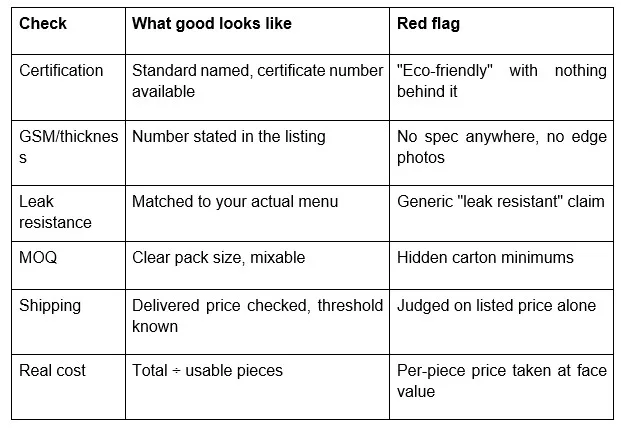
Run this once, and it becomes automatic. You'll spot a weak listing in about thirty seconds after the first few times.
Before you order
You don't need to become an expert on materials to shop well. You just need to ask better questions than the listing wants you to ask.
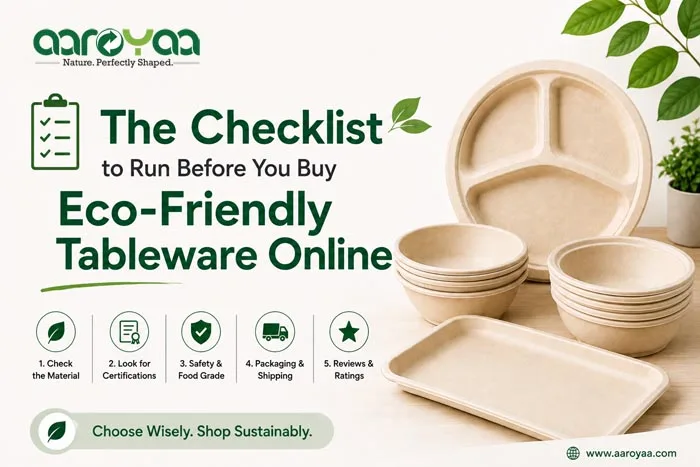
Certification wording. GSM. Leak resistance against your menu. MOQ. Shipping weight. Real per-piece cost. Six checks, four minutes.
When you're ready to buy biodegradable plates India-made and shipped from Bhopal, start with the combo collection if you're ordering for a home or an event, or head to bulk orders if you're stocking a café, kitchen or venue. Piece counts, sizes and pricing are stated on every listing — so you can run this checklist on us too.
That's rather the point.
Frequently Asked Questions
Common questions related to this article.
Is it safe to buy biodegradable plates India-wide without seeing them first?
Mostly yes, if you do two things. First, check that the listing names a standard rather than just using green-sounding adjectives. Second, order a small pack before committing to a large one — most sellers offer packs of 10 or 25 exactly for this. Testing a sample with your own food answers more questions than any product description will. Once you've confirmed the plate handles your menu, scaling up is low risk.
What GSM should I look for in a bagasse plate?
It depends on the food. For dry snacks and light servings, a lower GSM is perfectly fine and cheaper. For gravy, rice dishes and full meals, you want a noticeably denser plate — and the more useful signal is often per-plate weight and the depth of the moulding, since a well-moulded rim adds rigidity that a flat plate of the same GSM won't have. If a seller won't share the number at all, that's your answer.
Are combo packs actually better value, or just convenient?
Both, usually — but for a specific reason. The savings come less from the discount and more from shipping consolidation and from not over-ordering any one item. When you buy plates, bowls, cutlery and glasses separately, you tend to end up with 100 spoons and 30 plates. A combo is sized as a set. For a single event or a month of household use, that's genuinely cheaper. For ongoing commercial use, individual SKUs in bulk will beat combos on per-piece cost.