Bowl Sizes Decoded: 180ml vs 350ml vs Meal Tray - What Actually Fits What
Nobody thinks in millilitres.
You think in raita. In one katori of dal. In a bowl of Maggi that doesn't spill when someone carries it across a room. But every listing for eco-friendly tableware online is written in millilitres, so you end up guessing — and guessing wrong costs you either a spill or forty extra bowls you didn't need.
This article fixes that. It's not exciting. It is, however, the thing people most often get wrong, and it takes about four minutes to never get wrong again.
The first thing nobody tells you: rated capacity isn't usable capacity
A 180ml bowl does not hold 180ml of dal.
It holds 180ml if you fill it flush to the rim, which nobody does, because the moment someone picks it up, it's on their shirt. Real usable capacity for anything liquid is roughly 70 to 75 per cent of the rated number.
So think of it this way:
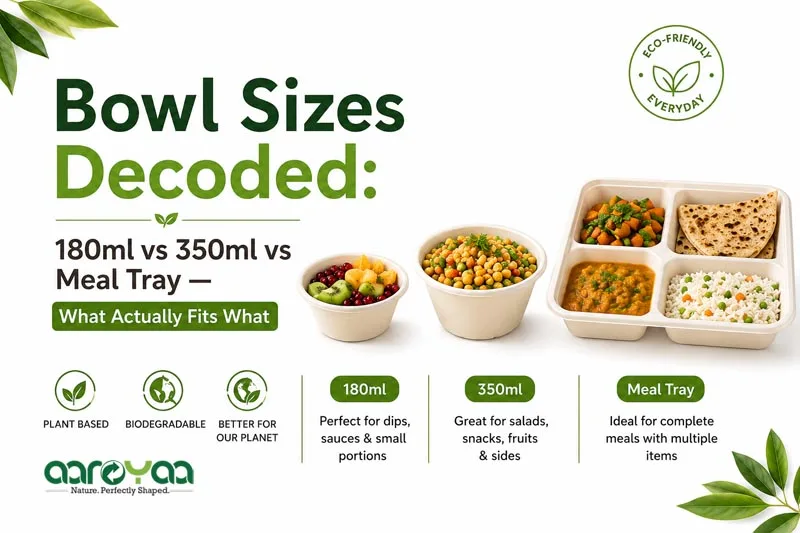
A 180ml bowl practically holds about 130ml. That's a small katori.
A 350ml bowl practically holds about 250ml. That's a proper serving bowl.
For dry or solid food — dry sabzi, snacks, sweets — you can go closer to the full number, because it doesn't slosh. For anything with gravy, thin curry, soup or chai, apply the discount. This one adjustment prevents most of the sizing mistakes people make.
What a 180ml bowl is actually for
Small. Single-portion. Side, not main.
Picture the steel katori that sits at the edge of a thali. That's the job.
It works well for raita, and this is probably its most common use in Indian settings — a serving of boondi or cucumber raita alongside a meal fills it properly without looking mean. It handles dessert neatly: gulab jamun with a little syrup, a scoop of kheer, halwa, custard, ice cream at a party. It's right for curd, plain or sweetened. It suits chutney and sauces at a stall, where portion control matters. And it's fine for dry snacks in small servings — namkeen, peanuts, roasted chana.
Where it fails: anything that is the meal. Put dal-chawal in a 180ml bowl and your guest will be back in ninety seconds. Put hot rasam in it and it'll be filled to a level nobody can carry.
Verdict: buy 180ml when it sits next to something else on the plate.
You'll find these in our Tableware Category, paired with trays — which is the correct pairing, because that's exactly how a side bowl is meant to be used.
What a 350ml bowl is actually for
Nearly double the volume. Completely different job.
This is a bowl someone eats from, not alongside.
Maggi and noodles are the obvious ones, and the reason we named a combo after it. A standard packet of instant noodles with its water comes to a bit more than 300ml once cooked and served — it fits a 350ml bowl properly and would overflow a 180ml one twice over.
Curry and gravy dishes work here. Chole, rajma, paneer butter masala, a serving of dal that's meant to be a portion rather than a garnish. Soup fits, with room to carry it. Biryani or pulao in a bowl format, at a stall or counter, sits comfortably. And it takes fruit, salad, or a chaat portion without needing a plate underneath.
Where it fails: as a side bowl. Serve raita in a 350ml bowl, and it looks like you forgot to fill it. Worse, it takes up more space on a tray or table than the portion justifies, and at a buffet, table space is the constraint nobody plans for.
Verdict: buy 350ml when the bowl is the meal.
Our Chai Maggie Combo pairs fifty of these with fifty tea cups, which tells you the intended setting — a snack counter, an office pantry, a small evening gathering.
Where the 3-compartment meal tray comes in
Different tool entirely. Not a bowl, not really a plate.
The tray gives you one flat surface with three separated sections. Its whole purpose is keeping wet away from dry on a single item — so rice stays in one section, curry in another, and a dry sabzi or salad in the third.
It's genuinely the best choice when:
● You're serving a complete meal in one piece — office lunches, food stalls, a mid-day meal counter
● You need takeaway where the food will travel and shouldn't merge
● Guests are eating standing up, because one tray in one hand beats a plate plus two bowls
● You want to reduce your item count, which reduces both cost and waste
It's the wrong choice when the meal has more than one gravy dish, because you'll run out of compartments and end up handing over a bowl anyway. It's also the wrong choice for a formal sit-down meal, where a proper plate and separate katoris simply look better.
Verdict: the tray replaces a plate plus two bowls. When that trade works, it's the cheapest and cleanest option on the shelf.
Now decide by occasion, not by size.
Here's where it becomes practical. Pick your setting and the sizes fall out on their own.
A sit-down dinner at home. One 9-inch round plate per person, one 180ml bowl per person for dal or raita, and a second 180ml bowl if you're serving dessert. Skip the trays entirely.
A festival lunch or large family gathering. Plate plus two 180ml bowls per person, minimum. Sweets go in their own 180ml bowls, and people take more than one. Order about 30% more small bowls than you think you need — this is the single most common shortfall.
Office lunch or a food stall. Meal trays, one per person, and that's often the whole order. Add 350ml bowls only if there's a curry that won't fit a compartment.
Chai and Maggi evening. Tea cups and 350ml bowls, roughly two cups per person across the evening. No plates required.
A birthday party or buffet. Plates for the main food, 180ml bowls for cake and ice cream, and remember that people put a plate down and take a fresh one. Budget 1.3 plates per guest. Every time.
A wedding or catered counter. This one deserves an actual conversation rather than a guess — volumes are high enough that the wrong size ordered in bulk is an expensive mistake. Our bulk orders page is the right starting point.
Two honest limitations worth knowing
If you're going to buy biodegradable plates made in India from us or anyone else, you should know where the material draws a line.
Very thin, very hot liquid sitting for a long time is the hard case. A bowl of rasam or thin sambar that sits untouched for thirty-odd minutes is the toughest test for any moulded fibre bowl. It'll hold for a normal meal. It's not designed to be a storage container.
And no disposable bowl is a reheating vessel for oily food over long cycles. If someone's going to microwave a heavy gravy repeatedly, glass or steel is genuinely the better answer, and we'd rather say so than sell you the wrong thing.
Neither of these matters for the vast majority of events. Both matter enormously if your use case is the exception, which is why they're worth stating plainly.
The short version
180ml is a side. 350ml is a meal. The tray replaces both when the food is dry-and-wet in one go.
Fill any of them to about three-quarters if there's gravy involved. Count guests, not pieces. And order more small bowls than feels right, because dessert always catches people out.
Where to start
Sizes are the easiest thing to get wrong and the cheapest thing to get right. Ten seconds of thinking about your actual menu beats any amount of comparing listings.
If you're serving a full meal, look at the combo packs — they pair trays and bowls in ratios that already make sense together. If you know exactly what you need, the tableware collection has the individual sizes, and drinkware covers cups and glasses.
And if you're still unsure which size fits your menu, ask us. We'd rather answer a question than process a return.
Frequently Asked Questions
Common questions related to this article.
How many 180ml bowls do I need per person?
Two is the realistic answer for a full Indian meal — one for dal or raita, one for dessert. If you're serving both a raita and a sweet, that's already two before anyone asks for a second helping of kheer. For a simple lunch with a single side, one per person is fine. The failure mode is almost always under-ordering the small bowls while over-ordering plates, because plates feel like the important item and bowls don't.
Can a 350ml bowl handle hot Maggi and curry without going soft?
For normal serving and eating time, yes — that's the standard use it's built for. The variable isn't the heat as much as the duration. Food eaten within fifteen or twenty minutes is well within what the bowl handles. Food left standing for a long stretch, particularly something thin and very hot, is where any fibre bowl starts to soften. For a snack counter or a party, this simply isn't an issue.
Is a meal tray cheaper than buying a plate and bowls separately?
Usually yes, and the saving is bigger than it looks. One tray replaces three items, which cuts your per-guest cost, your storage space and your shipping volume all at once. The catch is flexibility — a tray commits you to a specific meal shape. If your menu has two gravies or a runny dessert, you'll be adding a bowl anyway, and the advantage shrinks. Decide from the menu, not from the price.
More stories from Aaroyaa
Sustainable Disposable Dinnerware: How to Build a Full Setup from Scratch

Biodegradable Food Containers: What They Are and How to Choose the Right Ones