From Sugarcane to Supper: How Bagasse Becomes Biodegradable Tableware
Before it held your biryani, that plate might have started as the fibrous remains of a sugarcane stalk.
It’s an unlikely beginning for something sitting neatly on a dinner table. Yet bagasse-based biodegradable tableware begins with precisely this material: the fibre left after sugarcane is crushed to extract its juice.
How does a loose, rough mass transform into a plate with a smooth rim, and separate spaces for dal, rice and sabzi? Let’s find it out together.
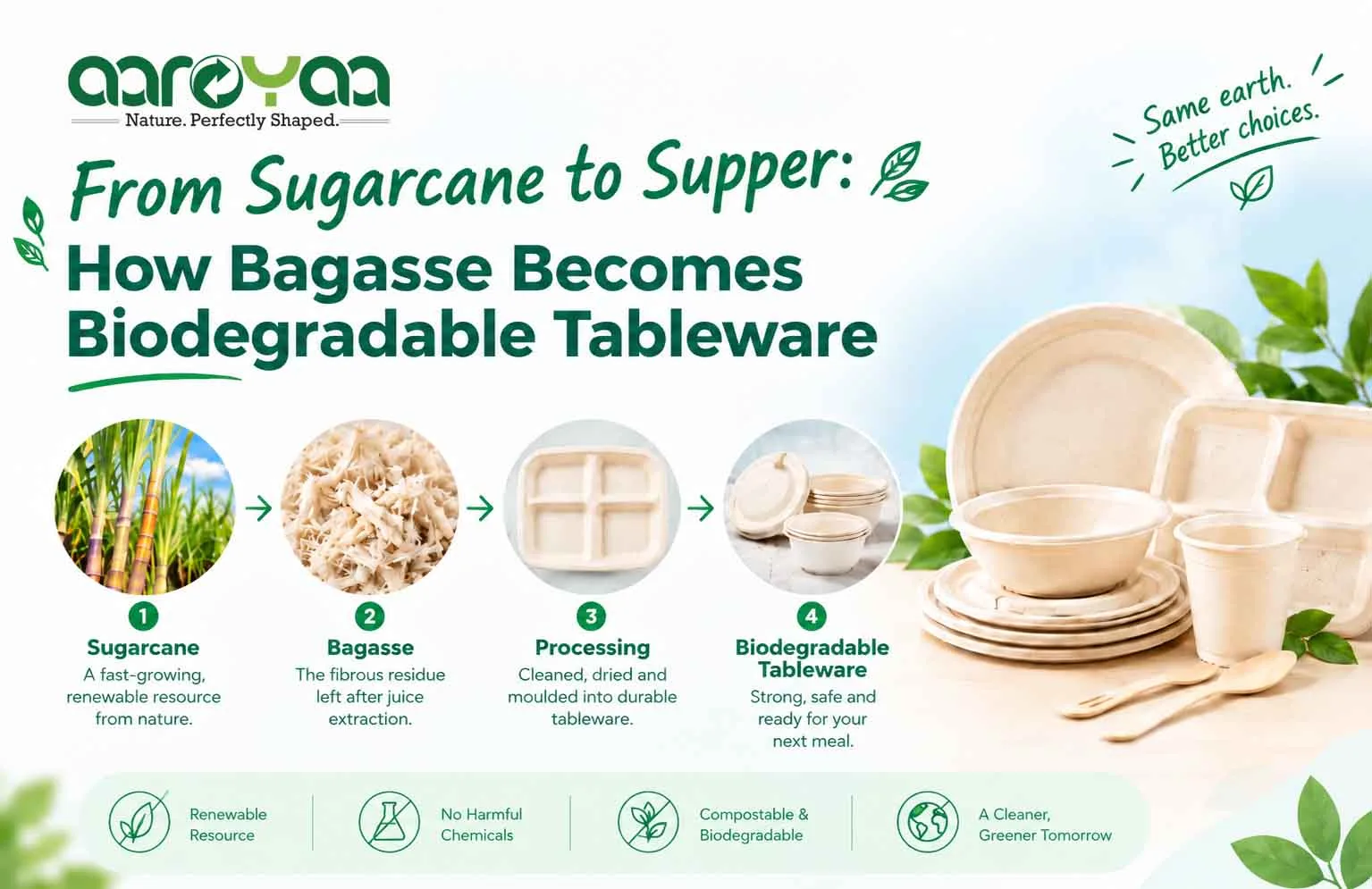
How Biodegradable Tableware Is Made:
The typical chain of events looks like this:
Sugarcane → leftover bagasse → prepared pulp → wet moulded shape → heated pressing → inspection → your table
Individual factories may use different equipment and formulations, but these are the key elements in the production of moulded bagasse tableware.
1. The Juice Leaves. The Fibre Stays.
Our story begins at a sugar mill, where sugarcane is crushed and its juice extracted. What remains is bagasse, a fibrous agricultural byproduct.
In order to use it for tableware, that material needs to be processed. Processing may include removal of the soft pith, followed by cooking the fibres. It also involves washing and screening to produce suitable pulp. These steps are part of a documented sugarcane-pulp manufacturing process.
So the plate doesn’t begin as raw cane pushed straight into a mould. Several changes happen before it reaches anything resembling dinnerware.
2. The Fibres Become a Watery Pulp
Imagine a water tank in which fine fibres from plants are swimming around.
In the process known as pulping and refining, prepared bagasse is transformed into a slurry. In some tableware manufacturing facilities, purchased pulp boards are used as a starting material, which are then broken down in this process.
Uniformity is important here as it ensures that the fibres are distributed throughout the mould to give a consistent shape and finish. Canepulp's manufacturing overview describes this process, explaining how it contributes to the strength of the finished product.
It still looks nothing like a plate.
That changes at the next station.
3. Suction Creates the First Shape
The slurry meets a mould shaped like the intended product: perhaps a shallow plate, a deep bowl or a compartment tray.
Vacuum suction draws water away through the mould’s screen while the fibres collect on its surface. Gradually, a wet version of the product takes shape.
Think of draining water through a strainer, except here the surface determines the outline of the object being made. Moulding-equipment manufacturer Besure describes this vacuum-forming stage.
The result is recognisable, but still wet. It needs another transformation before it can carry supper.
4. Heat and Pressure Firm It Up
The wet figure is pressed into hot moulds to form its basic shape. Pressing and drying to give a precise form define the surface finish and dimensions of the final product.
It gives us the details that define the objects of manufacture: the rounded shape of a bowl, the rim on which we hold it, the partitions that separate different food items.
Our wet-press equipment combines forming, hot pressing, trimming and stacking in one continuous line.
There isn’t one recipe for all biodegradable tableware, though. Fibre blends and functional additives can vary, so appearance alone cannot tell you a product’s full composition or performance.
5. The Edges Are Finished, and the Products Checked
Excess material is trimmed where needed. Finished pieces are inspected before packing.
Checks can cover dimensions, weight, shape, edges and structural integrity, as described in Canepulp’s production process.
These details matter when you’re carrying a full plate across a busy room.
Aaroyaa’s guide to biodegradable tableware features checks for leak resistance, heat tolerance and durability prior to packaging. When choosing a product, it is important to follow advice relevant to the types of foods and serving conditions you intend to use them in.
Planning Eco-Friendly Wooden Dining at Home?
Bagasse can add to the appeal of a natural-looking setting, although this product is made from sugarcane fibre, rather than wood.
For events at which you will be requiring disposable tableware, consider your menu. A snack plate and a bowl for curry are different items, with various considerations. Size, intended use and instructions for disposal are among the factors to bear in mind before making a decision.
Explore Aaroyaa’s range of plates, bowls and trays and choose products suitable for your next meal. If you are looking for a trial run, order a smaller quantity to begin with, prior to hosting a larger party.
Next time you handle a bagasse plate, take a moment to study its contours. Those precise lines were once scattered sugarcane fibre. Understanding what has gone into the creation of your tableware is an informative experience, giving you confidence in your choice and an insight into the process.
More stories from Aaroyaa
Biodegradable Food Containers: What They Are and How to Choose the Right Ones
Biodegradable vs Plastic Tableware: Why the Eco Plate Costs More, and Where That Money Goes