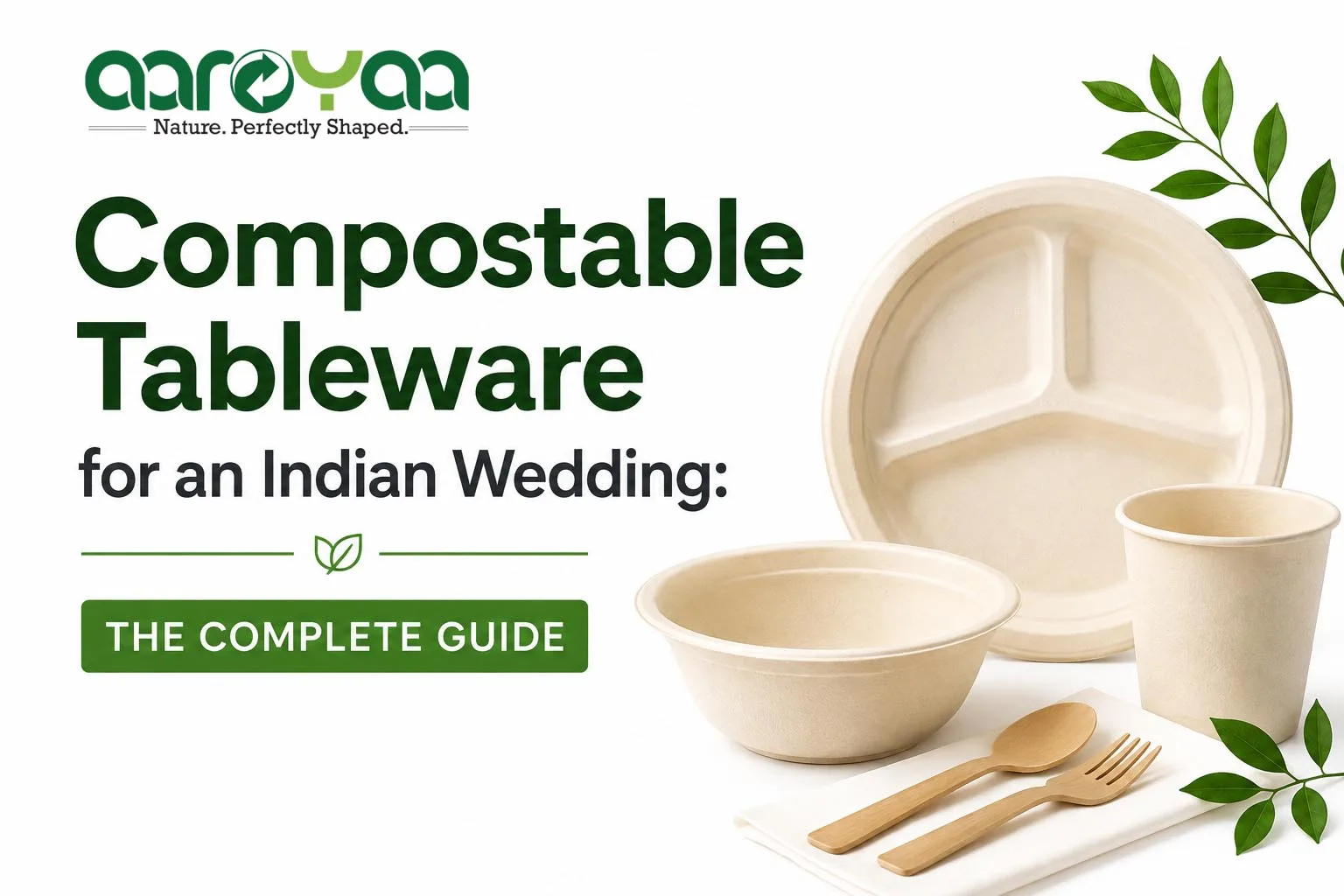
Somebody in the family has been handed "dining". If that is you, the first thing worth knowing is that compostable tableware for weddings is not one decision. It is five, because a haldi in the garden and a reception hall on the last night ask completely different things of a plate.
This guide walks through each function in order. How many pieces to buy, which size actually holds the food you are serving, what the whole thing costs, and the two or three places people quietly lose money without noticing.
No sales pitch until the end. If steel rental is the better answer for your wedding, that is said plainly in here too.
Start with the count, not the catalogue
Almost every ordering mistake starts the same way. Someone takes the guest list, say 300, and orders 300 plates.
Then the buffet opens, and people go back for a second round with a fresh plate. The staff eat. Twelve cousins arrive who never RSVP'd. By 9 pm, someone is sent out to buy whatever the nearest shop has, and it is thermocol.
So work function by function, and add a cushion.
For a served, sit-down meal, plan around 1.15 plates per head. People stay in their seat and mostly use one.
For a buffet, plan 1.35 per head. That extra third is the second helping and the plate somebody puts down and loses.
For standing service at a sangeet or cocktail evening, plan 1.6 per head. Small plates get abandoned on window sills constantly. This is normal, and you should budget for it rather than fight it.
Bowls follow the menu, not the guest count. One bowl per head for a single wet dish. If you are serving both a curry and a sweet that needs holding, that is two bowls per head, and pretending otherwise is how families end up serving gulab jamun on a paper napkin.
Spoons run about 1.5 per head across a wet-heavy Indian menu, because they go missing between the buffet line and the table.
Worked through for a 300-guest lunch buffet, that is roughly 405 plates, 300 to 600 bowls depending on the menu, and 450 spoons. Round every one of those up to the nearest pack. You will use the extras at the next function.
Haldi: the messiest one, and nobody plans for it.
Haldi is usually the smallest gathering and the one that ruins the most tableware. It is outdoors, it is daytime, there is turmeric on everything, and the food is snacky rather than a proper meal.
Small plates are the right call here. A 7-inch square or round plate holds a few pieces of what is being passed around without encouraging anyone to build a full meal. Aaroyaa's 7-inch square plate works out to about ₹3.40 a piece in the pack of 10, and the 7-inch round to about ₹3.20.
Add a 180 ml bowl for anything wet. Chaat, halwa, dahi. Roughly ₹2.60 each.
One warning about outdoor daytime functions. Wind. Light plates on a lawn will travel. Weight the stacks with something, and keep them out of the sun before service, because a warm stack separates badly when a guest tries to take one.
For 120 people at a haldi, 160 plates, 120 bowls and 160 small spoons come to a little over ₹1,000 in total. That is the entire tableware bill for the function.
Mehendi: the function where hands are out of action
This one has a genuine constraint that nothing else does. Half your guests have wet henna on both palms and cannot hold a plate, cannot pick up a samosa, and will not thank you for a plate that needs two hands to balance.
Feeding plan, quite literally. Food that a friend can hand across. Food that sits in a bowl and can be lifted with a spoon held awkwardly in one hand.
Bowls do more work than plates at a mehendi. Budget two per head rather than one, because guests here graze over three hours instead of eating one meal. The 180 ml bowl handles most of it.
Wooden sporks are useful here. One piece, ₹1.52 each, and a guest managing with the back of one hand can still use it. Separate forks and spoons on the same table mean dropped cutlery on a lawn.
For 150 guests: 300 bowls, 150 small plates and 300 sporks is close to ₹1,700.
Sangeet: one-hand rule
At a standing sangeet, every guest has a glass in one hand. Which leaves exactly one hand for everything else.
That single fact should drive the whole decision. A plate that needs the other hand to hold a spoon is a plate that gets put down on the nearest flat surface and never picked up again.
Two workable options. A 7-inch round plate with food that can be eaten in one bite, no cutlery at all. Or a compartment plate, so gravy does not run into the dry items when the plate tilts, which it will. The 9-inch 3-compartment round plate sits at about ₹5.96 a piece.
Remember the 1.6 multiplier here. It feels excessive when you are placing the order. It will not feel excessive at 11 pm.
Two hundred and fifty guests at a sangeet need roughly 400 plates and 400 sporks. About ₹1,900.
The wedding day: volume, gravy and heat
This is the function where compostable tableware for weddings earns its place or embarrasses you, and it comes down to one thing. Does the plate hold up under rajma, sambar or a proper biryani for the twenty minutes a guest takes to eat?
Bagasse handles this better than plain paper. It is the fibre left over after sugarcane is crushed, pressed into shape, and it does not go soft and floppy the way a thin paper plate does under something wet and hot. That is the practical reason it became the default at Indian weddings rather than a moral one.
For a buffet, the compartment plate is worth the extra rupee or two. Guests are walking with the plate, and separated sections mean the dal does not reach the halwa. The 9-inch 3-compartment round plate is the workhorse. For a fuller thali, the 3-compartment meal tray is around ₹7.00 a piece or the 6-compartment version at ₹14.00.
Size is where people get it wrong. A 7-inch plate is a snack plate. It is not a meal plate, and if you put it on a wedding buffet, you will watch guests come back three times and use three plates, which costs more than buying the correct size once. For a full meal, 9-inch minimum. Eleven-inch if the menu runs to eight items or more, at about ₹7.56 a piece.
Add bowls for anything that needs holding. Rasam, kheer, curd, ice cream.
Three hundred guests, buffet, compartment plate route: about 400 plates at ₹5.96, 400 bowls at ₹2.60, 450 spoons at ₹1.13. That comes to roughly ₹3,900. Around ₹13 a head, for a function where the catering alone is running several hundred rupees a plate.
Reception: the one guests photograph
By the reception, everyone is tired, including the family. There is usually a stage, a queue, and a lot of standing around.
If the reception is a sit-down dinner, the meal tray is the cleanest option. Guests are dressed up, they are being photographed, and a tray with defined sections looks composed in a way a loaded flat plate does not.
If it is standing service again, go back to the sangeet logic.
The honest note here: this is the function where families most often want steel, and sometimes they are right. More on that below.
Four hundred guests, seated, using the 3-compartment meal tray with a separate dessert bowl and spoon: roughly ₹4,800.
What the whole wedding costs
Add those five functions together for the guest counts used above, which is a mid-size Indian wedding, and the tableware bill lands a little over ₹13,000.
That is the full run. Haldi, mehendi, sangeet, wedding lunch and reception. Plates, bowls and cutlery for every one of them.
Set that against what the wedding itself costs, and the number stops feeling like a decision worth agonising over. It is usually less than the flowers on one stage.
Prices quoted here come from the current listings on the site, and discounted prices move. For anything over about 2,000 pieces, ask for a bulk quote instead of adding packs to a cart. The per piece rate changes at volume.
Three places money quietly leaks.s
Check the per-piece maths yourself, every time. A bigger box is not automatically cheaper per piece. Some larger packs across the industry, this catalogue included in places, work out to more per plate than the small pack of the same item. Divide the price by the actual piece count before you assume the bulk box is a saving.
Do not buy cutlery you will not use. Combo packs bundling forks with spoons look economical until you realise that at an Indian wedding the forks sit untouched in a box while the spoons run out by the second function. Buy spoons separately in the quantity you actually need.
Order all functions together. Splitting the order across three deliveries in three weeks means paying shipping three times and risking a size being out of stock in the middle of the season.
Bagasse, areca, paper or steel
Four honest answers, because they are not interchangeable.
Bagasse is sugarcane fibre. It is the right default for volume; it handles hot, oily and wet food, it comes in the sizes Indian menus need, including compartment plates and trays, and it composts. This is what most compostable tableware for weddings is made from, and what Aaroyaa produces.
Areca leaf is the fallen sheath of the areca palm, pressed into shape. It looks more traditional and photographs beautifully, particularly for a haldi or a temple function. It costs more, the sizes are less consistent because it is a natural leaf, and it is harder to get in large uniform quantities at short notice.
Plain uncoated paper plates are cheap and fine for dry snacks. They are not fine for gravy. If someone quotes you a price that seems far below everything else, check whether you are being offered paper for a menu that needs bagasse.
Steel rental genuinely wins in some situations, and anyone selling you disposables who does not say so is not being straight with you. If your venue has a washing area, running water, and the caterer includes dishwashing staff in the package, steel is cheaper across a 400-guest wedding and produces almost no waste. Where it stops working is scale and timing. Somebody has to wash 1,600 plates, and at a wedding that happens at 1 am, usually by people who have already worked fourteen hours. Breakage and non-return charges also have a way of appearing on the final bill.
A lot of families end up splitting it. Steel for the seated reception, compostable tableware for wedding functions that are outdoors, standing, or spread across a lawn where collection is impractical.
What "compostable" actually means, and what it does not
Worth being clear, because the word gets used loosely.
Bagasse, areca and wood are plant material. They break down in a composting environment, which means a pit, a municipal composting facility, or a farm. Buried in a mixed landfill with plastic, they will break down far more slowly than the marketing suggests.
So the plate is only half the job. The other half is what happens to it the next morning.
Two practical things. Ask your venue whether they segregate wet and dry waste, and if they do not, arrange one clearly marked collection point for used tableware and food waste together, since they go to the same place anyway. And ask whoever handles your waste whether there is a composting facility in your city that accepts it. In many cities there is, and nobody asks.
The other thing to watch is a supplier selling you "compostable plastic". That is a real, separate category with real rules, and in India it needs IS or ISO 17088 test reports plus a certificate from the Central Pollution Control Board. If a supplier uses the word without producing paperwork within a day of you asking, treat it as ordinary plastic. Fibre plates skip that whole conversation, because they are not plastic at all.
When to order
Six months out, decide the format of each function. Seated or buffet, indoor or outdoor. You cannot count plates before you know this.
Six weeks out, place the order. This is the single most important line in this guide if your wedding falls between November and February. That season clears stock, and the items that vanish first are exactly the ones everyone needs at once: 9-inch plates, compartment trays and small spoons. A supplier who could deliver in four days in August may need three weeks in December.
Six days out, do a physical count of what arrived against what you ordered, and open one pack of each item. Not to inspect quality so much as to know what it looks like, so nobody is discovering the plate size for the first time while 300 people queue.
Store the boxes off the floor and away from damp. Bagasse absorbs moisture from a wet floor, and a monsoon wedding with boxes stacked in a garage is a genuine risk.
If you are ordering this month
Work out your count for the largest function first, since that order sets your pack sizes. Then add the smaller functions on the same purchase order rather than buying three times.
Aaroyaa makes bagasse plates, bowls, compartment thalis and meal trays in the sizes Indian wedding menus actually need, along with wooden cutlery, in quantities that suit a 100-guest engagement or a 1,000-guest reception. Everything is made in India by a women-led team based in Bhopal.
If you want help matching your menu to plate sizes, or a quote for a full wedding across all five functions, browse the tableware range or talk to the team about a bulk order.
Frequently Asked Questions
Common questions related to this article.
How many plates do I need for a 300-guest Indian wedding?
Around 400 for a buffet, and roughly 345 for a seated meal. The extra is for the second helping, the staff, and the guests who arrive without confirming. Bowls depend on the menu rather than the guest count: one per head for a single wet dish, two if you are serving both a curry and a sweet. Spoons run about 1.5 per head. Then round each item up to the nearest pack size, since the leftovers get used at the next function anyway.
Is compostable tableware for weddings actually cheaper than renting steel?
Not always, and it depends on your venue. Steel rental usually costs less per use across a large seated function if the hall has a washing area and your caterer's package includes dishwashing staff. What it costs you instead is labour and time, since somebody washes those plates late at night, plus breakage and non-return charges on the final bill. Compostable tableware wins on outdoor functions, standing service, and anywhere collection and washing is impractical. Plenty of families use both, steel inside and fibre plates on the lawn.
Which plate size should I use for a wedding buffet?
Nine inch as a minimum for a full meal, and 11 inch if the menu has eight items or more. A compartment plate is worth the small extra cost on a buffet, because guests eat standing or walking, and the sections stop gravy from running into everything else. Keep 7-inch plates for snacks at the haldi, mehendi or sangeet. Putting a 7-inch plate on a wedding buffet backfires, since guests simply return for a second and third plate, which costs more than buying the right size once.
More stories from Aaroyaa
Sustainable Disposable Dinnerware: How to Build a Full Setup from Scratch

Biodegradable Food Containers: What They Are and How to Choose the Right Ones