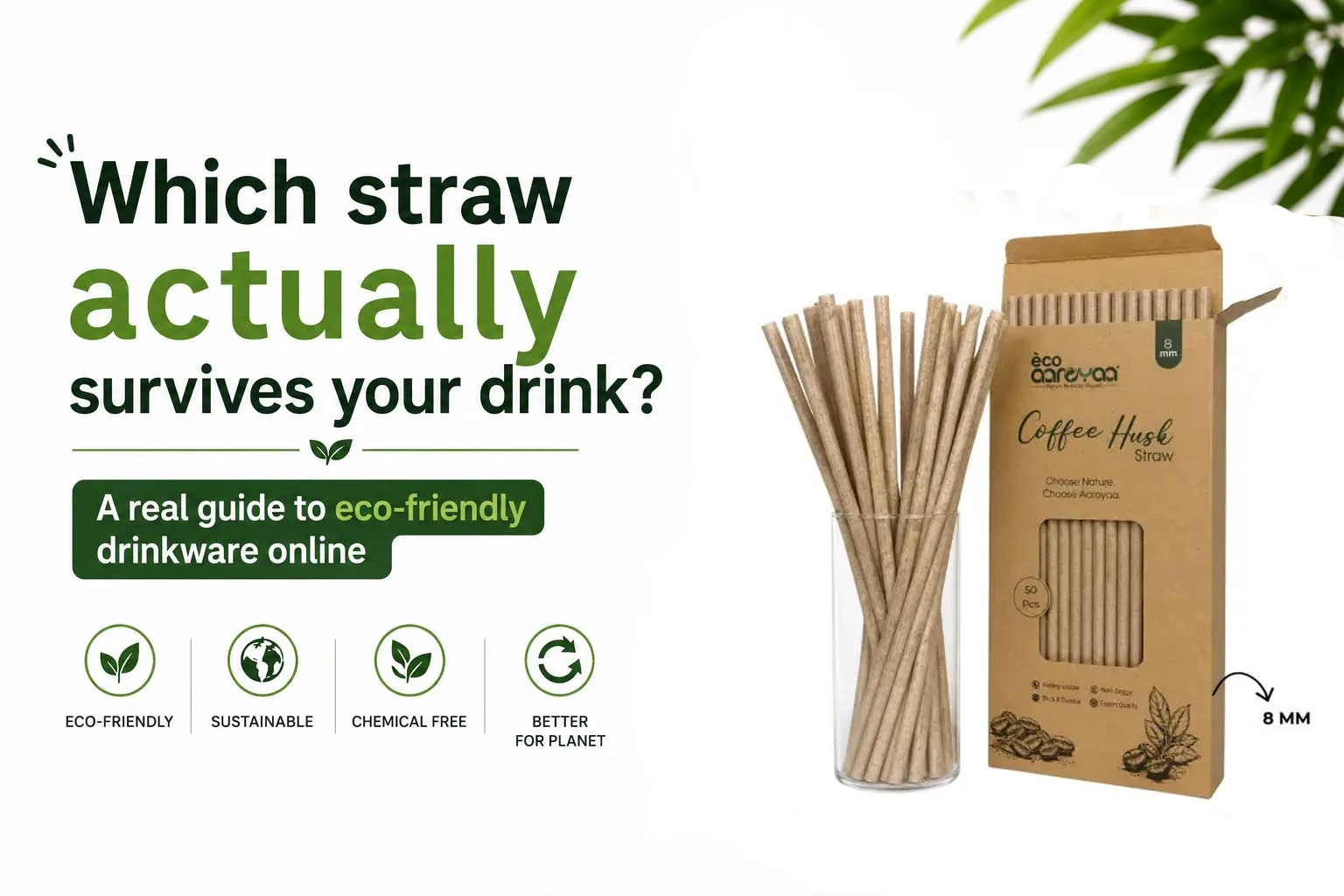
Which straw actually survives your drink? A real guide to eco-friendly drinkware online
You know the moment. Half your cold coffee is gone, the ice has started to melt a little, and the straw begins to fold in on itself like wet cardboard. You push it back into shape. It falls again. By the last few sips, you're just drinking from the glass anyway, a soggy wad of paper bobbing uselessly at your side.
This is the single most common complaint people have about eco-friendly drinkware online, and most brands quietly avoid answering it. We would rather answer it properly, even where the answer makes one of our own products look average. If you are about to buy biodegradable drinkware India has plenty of options for, you deserve to know which one fails, when it fails, and why.
Short version before the details: steel wins for home use, and it is not close. Paper loses badly in milkshakes. Coffee husk sits in between and costs a lot more. Sugarcane straws are good on paper but harder to actually find in India.
Why we all ended up with soggy straws in the first place
On 1 July 2022, India banned the manufacture, import, stocking, sale and use of 19 single-use plastic items, including straws, plates, cups, cutlery and thermocol decoration. The items have been categorised as low utility but high littering by the Ministry of Environment.
The ban was the right call. The rollout was messy. Cafés and caterers had days to swap suppliers; most grabbed the cheapest paper straw available, and customers got a worse drinking experience overnight. That first impression stuck. A lot of people now believe every eco straw goes soggy, which simply is not true.
Enforcement of bans remains uneven throughout the country, and prohibited items continue to appear on the market. However, if you are a cafe owner, an operator of a cloud kitchen, or a juice bar, the use of plastic straws is definitely not a grey zone. It is illegal, and in many places, such a manifestation of disregard for the law is simply unacceptable.
Paper straws are affordable, transparent, and limited
Let’s begin the discussion from the bottom, from the cheapest option, which, however, is now presented with a high degree of integrity.
Paper straws work by spiral-winding layers of paper and bonding them with food-safe adhesive. Cheap ones use a single thin layer and weak glue. Better ones use three or more layers and a tighter wind. That difference is enormous in practice, and it is invisible from the outside, which is exactly why people give up on paper entirely.
Here is where the industry starts disagreeing. Paper straw manufacturers claim that sogginess is a quality control issue, and that a properly produced multi-layer straw will hold up in an ice-cold drink for hours. Plant-fibre straw dealers counter that paper will inevitably soften, and that hot, acidic, or otherwise aggressive beverages will always have consequences for the straw’s integrity regardless of how well it is made.
Both sides have a point, and both sides are selling something. Our own read, from handling a lot of these: a good paper straw is fine for water-based cold drinks over a normal 20 to 30 minute sitting. It is not fine for a thick milkshake you nurse for an hour, and it is not fine for hot chai.
Verdict on paper: excellent value for cold, thin drinks. A poor choice for milkshakes, thick lassi and hot beverages.
The pricing is what keeps paper in the game. Our 8 mm paper straw pack of 100 currently works out to ₹1.25 per straw. The 6 mm pack of 100 is ₹1.83 per straw. At those numbers, a 300-guest function costs you a few hundred rupees in straws. Nothing else in this comparison comes close.
Coffee husk straws: the middle path nobody expects
Coffee husk is the papery skin left over after coffee cherries are processed. It used to be waste. Now it gets compressed into straws with genuinely different behaviour from paper.
The wall is denser and less absorbent. It does not go limp the way a single-layer paper straw does, and it holds its shape for a longer sitting. There is a faint natural aroma to it, which some people like in a cold coffee and some people find odd in a nimbu paani. Try a small pack before you commit to a big one.
Now the honest part. Coffee husk is expensive. Our 6 mm coffee husk straw pack of 50 comes to ₹10.38 per straw. The 8 mm pack of 50 is ₹13.58 per straw. That is roughly eight to ten times the cost of a paper straw.
For a cafe selling 200 cold coffees a day, that's a difference of roughly ₹2,000 a day. Most would prefer to leave that money in the register. So let's say, ungenerously, that coffee husk straws are not a good default option for high-volume cafes. They're great for boutique shops, for special occasions and higher-end drinks. For weddings, for branding, for people who have decided that soggy straws are an unacceptable price to pay for the convenience of a cold brew.
If that is you, buy the smallest pack first. A pack of 25 at ₹11.17 per straw is a cheap way to find out whether your customers notice the difference before you order 5,000.
Verdict on coffee husk: the most reliable disposable straw we stock, priced like a premium product, because it is one.
Sugarcane straws: good idea, awkward reality
Sugarcane fibre straws come from bagasse, the crushed cane pulp left after juice extraction. It is the same raw material behind bagasse plates and bowls, and the durability claims are strong. Manufacturers say sugarcane straws reinforced with natural binders stay rigid for hours and handle heat far better than paper.
We do not stock sugarcane straws, and we would rather say so than pretend otherwise. Our drinkware range currently runs to paper straws, coffee husk straws, bagasse cups, glasses, dip cups and sipper lids. Straws made from sugarcane are not in it.
If you find them elsewhere, ask two questions before ordering: what is the binder, and is there any independent compostability certification? Sugarcane fibre is a good story, and good stories attract loose claims.
Verdict on sugarcane: promising material, but check the certification rather than the marketing.
Steel: the honest winner, for exactly one situation
We sell disposables. We are still going to tell you that steel beats everything we have if you are drinking at home.
A steel straw never softens, never changes the taste after a rinse, and lasts years. Buy four, keep a cleaning brush in the drawer, and the soggy straw problem disappears from your life permanently. On cost per use, it is not even a contest. Nothing we sell can match a straw you use 800 times.
Steel is also the wrong answer for most of the people reading this. You cannot hand out 400 steel straws at a wedding and expect them back. A cloud kitchen cannot ship one with a delivery order. A juice counter cannot wash them fast enough between customers, and washing them badly is worse than not using them at all, because the inside of a straw is hard to inspect.
Verdict on steel: the best choice for home use, and unusable at any scale where you do not get the straw back.
That is the actual dividing line in this whole comparison. It is not paper versus plant fibre. It is whether the straw comes back to you or not.
The 6 mm and 8 mm decision matters more than the material
This is the part most guides skip, and it fixes more complaints than switching materials does.
A 6 mm straw is for thin liquids. Water, nimbu paani, iced tea, most juices, soft drinks, cold chai. The narrow bore keeps the drink flowing, and the straw stays comfortable.
An 8 mm straw is for anything thick. Milkshakes, thick lassi, cold coffee with a scoop of ice cream, smoothies, anything with pulp or bits. When people suck hard on a 6 mm straw because the drink is too thick to move, the vacuum pulls the walls inward, and the straw collapses. That is not always the material failing. That is the wrong diameter, and it happens to good straws too.
We stock both sizes in paper and in coffee husk. If your customers keep complaining, check the diameter before you change your supplier. It is a free fix.
Two things worth knowing before you spend
A research team experimented with paper, PLA, and regular old PP plastic straws by burying them in natural soil for 30 days. Compared to the paper straw, which was rapidly decomposing, the PLA straw had only lost a barely perceptible 0.3% of its weight. This is almost the same as the regular plastic straw. PLA requires industrial composting to break down, which is not available in most parts of India. If a seller is advertising smooth plastic-like “biodegradable” straws at a suspiciously low price, it is worth asking yourself what polymer they are using because, in reality, PLA in Indian composting conditions will behave much like regular plastic. The same study found that PLA becomes significantly softer when exposed to temperatures over 55 °C, making it unsuitable for hot drinks anyway.
The second finding surprised us. In a survey of 68 people from the same research, the factors that most affected whether someone wanted to buy a drink were whether the straw pierced the sealed lid cleanly and whether it snapped while doing so. Sogginess and mouthfeel had far less effect on purchase intent than expected. If you serve sealed cups, a straw that bends at the lid is costing you more than a straw that softens near the end.
Worth pairing that with your lid choice. Our 90 mm sipper lid at ₹7.08 per piece and the 80 mm version at ₹7.60 per piece are both designed for straw use, so check the straw and lid together rather than separately.
So what should you actually order?
If you drink at home, buy steel and stop thinking about it. Keep a small pack of paper straws for guests.
If you run a café or juice counter with high volume and thin drinks, paper at ₹1.25 to ₹1.83 per straw is the sensible call. Go 6 mm for juices and soft drinks, 8 mm for anything with body.
If you serve milkshakes, thick lassi or cold coffee as a signature item, paper will keep generating complaints. Coffee husk in 8 mm is the fix, and you may want to price it into the drink rather than absorb it.
If you are planning a wedding, a corporate event or a festival stall, mix them. Paper for the water and soft drink counters. Coffee husk at the speciality drinks counter where guests linger. For volumes like that, our bulk orders page is a better starting point than the standard cart.
If you are stocking a cloud kitchen, the straw is only part of it. Look at the 55 ml tea cups at ₹4.03 per piece and the 250 ml glass at ₹10.92 per piece alongside your tableware and kitchenware so the whole order arrives together.
Ready to stop apologising for your straws?
You do not need to solve this perfectly. You need to match the straw to the drink, get the diameter right, and stop buying the cheapest option on the marketplace listing.
Browse our full drinkware collection to compare paper and coffee husk straws, cups, glasses and sipper lids side by side. Start with a small pack, test it against your actual menu for a week, and scale what works.
Planning something large, or not sure which size fits your cups? Talk to us. We would rather help you order the right thing once than have you order the wrong thing twice
Frequently Asked Questions
Common questions related to this article.
How long does a paper straw last before it goes soggy?
In a cold, thin drink like juice or a soft drink, a well-made multi-layer paper straw should comfortably last a normal 20 to 30 minute sitting. In a thick milkshake or a hot drink, it will soften much faster, sometimes within minutes, because heat breaks down the paper fibres and thick liquids force you to pull harder on the straw. Acidic and carbonated drinks also weaken paper faster than plain water does. If your straws are failing inside ten minutes in a cold drink, that is a quality or diameter problem, not a normal limit of the material.
Are coffee husk straws worth the extra cost over paper?
It will depend on the product you are using. For juice counters where you expect large volumes, no, paper at Rs 1.25-1.83 per straw will be more cost-effective than any of our ranges. However, for milkshakes, cold coffee, weddings or other premium café services, our straws will be a welcome treat since customers can see the value added, and they also work for thicker drinks. Our coffee-husk straws range from Rs 10.38-Rs 14.37 per straw, depending on the size and quantity ordered. You can order 25 first to try out with your drinks.
Is every straw sold as biodegradable actually compostable in India?
No, that’s precisely the point. PLA straws are not biodegradable; they require high-temperature industrial composting, which is hard to find anywhere in India, as the test shows. The test shows that buried in soil, PLA straws lost less than 0.3% of their mass over 30 days, basically behaving like regular plastics. Paper straws and natural fibre straws are the biodegradable ones. So if you are buying biodegradable straws anywhere in India, ask to make sure that they’re not PLA straws (they are often marketed as corn straws), and ask whether they are compostable certified, not just biodegradable.
More stories from Aaroyaa
Biodegradable Food Containers: What They Are and How to Choose the Right Ones
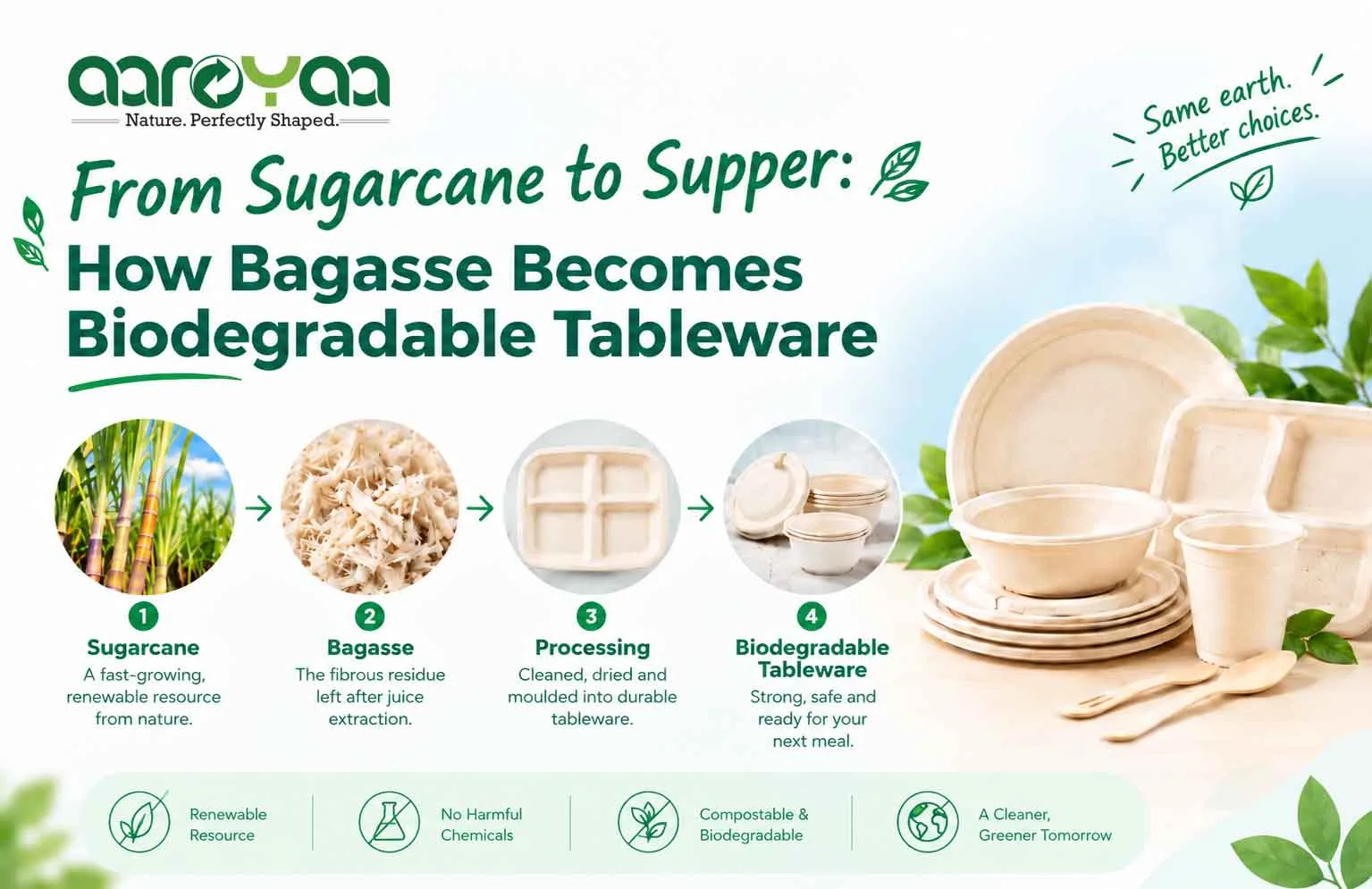
From Sugarcane to Supper: How Bagasse Becomes Biodegradable Tableware